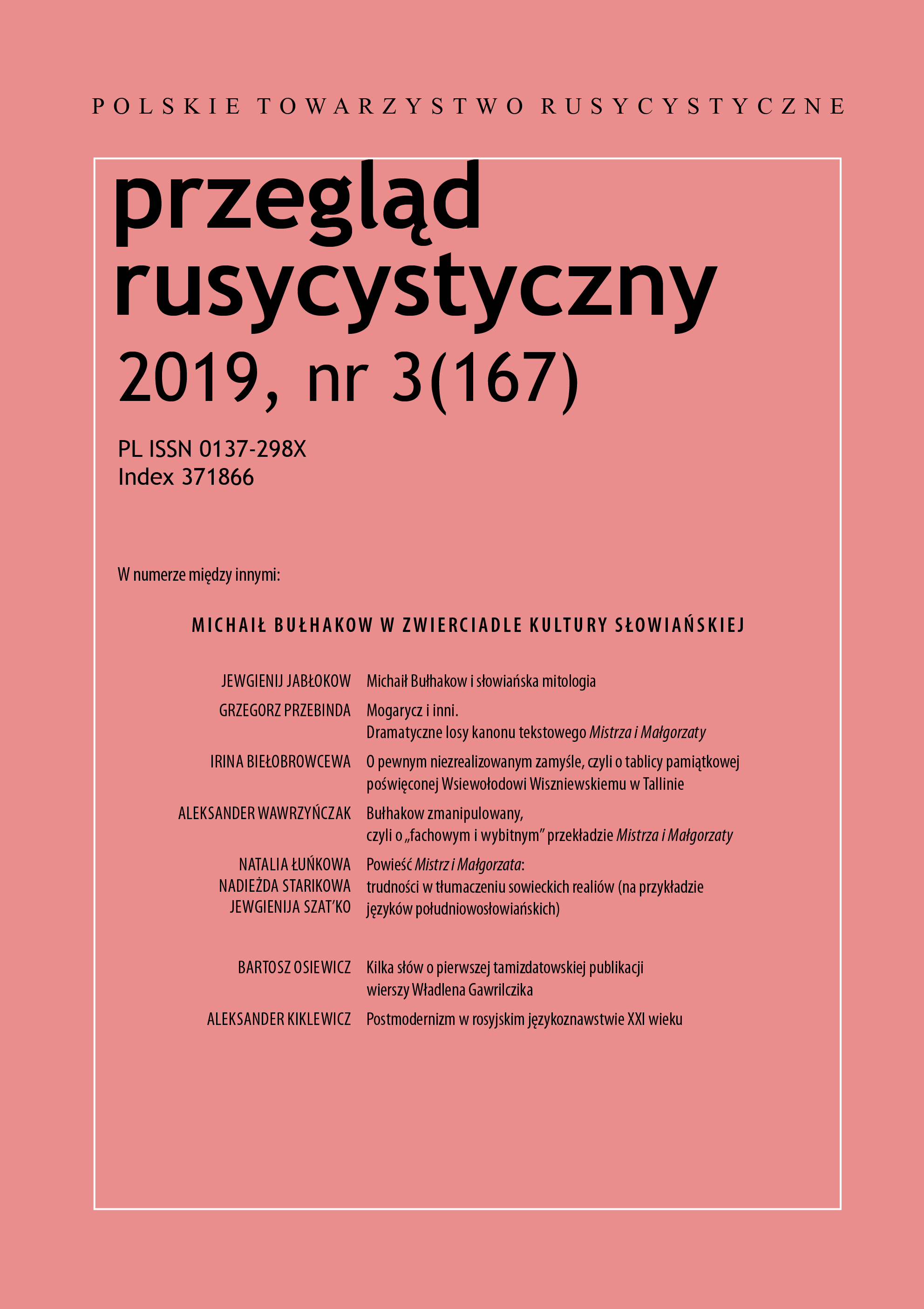
The article examines the mythological subtext of Bulgakov's works. The author assumes that motifes of Slavic mythology (both in pagan and Christian versions) occupy an important place in this subtext. The functioning of the "snake-and- chicken"'s discourse in Bulgakov’s novel "Fatal Eggs", stories ("Towel with a Rooster", "The Steel Windpipe "), plays ("Zoyka's Apartment", "Flight ") is considered. The analysis of mythological allusions clarify the interpretation of the writer's works and let specify the structure of his artistic world.
The starting point for my reflections, which ultimately aim to bring researchers and readers closer to the issue of the textual canon of The Master and Margarita, is the problem of the presence or absence of the famous passage about Mogarych in Chapter Thirteen of the novel. I have tried to demonstrate that the presence of this passage in the first Polish translation by Irena Lewandowska and Witold Dąbrowski, as well as its omission in the second translation by Andrzej Drawicz, are textologically justified. This is due to the fact that translators used different original editions as the basis of their work. My study, which is the first of the planned longer cycle, ends with a discussion of the most recent version of the text of The Master and Margarita, put forward in 2014–2015 by the indefatigable researcher of Bulgakov archives — Elena Kolysheva.
The article presents a paradoxical fact of using the name of Mikhail Bulgakov in the newspaper discussion of perestroika, when in 1987 a group of Estonian intellectuals opposed the intention to establish inTallinna memorial board to the writer Vsevolod Vishnevsky, a fierce apologist of Soviet power. The existence of censorship prevented direct expression, and Estonian writers found a euphemistic move, arguing the impossibility of perpetuating the memory of Vishnevsky as the organizer of the persecution of Mikhail Bulgakov. The deconstruction of relevant texts of articles published in the Estonian and Central Soviet press, carried out in the article, demonstrates the transformation of polemics in the "literary field" in the confrontation at the national and social level. In the changing socio-political conditions, the name of the writer Mikhail Bulgakov, disgraced in the 1920s-1930s, acquires a decisive force.
The main aim of this article is the analysis of the new translation into Polish the Mikhail Bulgakov’s masterpiece, The Master and Margarita, which was made by Barbara Dochnalik and published at 2018. This edition also includes two interpreter’s afterwards. Both texts are full of controversial facts about the writer’s biography, even more, the majority of them are not covered with the documents about Bulgakov’s life and the story of the creation of his novel. Some of interpretation of several motifs of The Master and Margarita, made by B. Dochnalik, are questionable, too. But the main doubts are caused by the way of translation and its quality. The translation made by Dochnalik includes some fragments, which wasn’t created by Bulgakov and highly likely were putted into the polish text of the novel by the translator, probably because of her aim to prove her own interpretation of The Master and Margarita.
This article let to know the most ridiculous samples of the translator’s manipulations with the Bulgakov’s novel, which could be called scandalous.
The article deals with the ways of transferring words and phrases naming things, phenomena, and objects typical for life, daily routine and culture of the Muscovites during the first decades of Soviet power, used for translation of the novel “The Master and Margarita” into South Slavic (Bulgarian, Serbian, Croatian, Slovenian) languages. The complexity of the novel’s artistic structure, the combination of several cultural, historical and religious traditions, stylistic and linguistic layers, possess a very difficult task for translators. One of the necessary conditions for its solution is the presence in the translated edition a reference device (reference comments) explaining difficult passages.
In 1977 in Paris, the literary almanac «Аполлон-77» was published, the editor of which was a Russian painter and sculptor Mikhail Shemiakin. Among many works of writers banned in Soviet Russia, there were 20 poems of the "classic of Leningrad nonconformity" – Vladlen Gavrilchik (1929-2017). This article is an attempt to analyze them. Gavrilchik’s poems published in the Parisian almanac show his journey through the avant-garde literary tradition. Moreover, they prove that the artist profusely draws from children's folklore, skilfully uses flaws, irony and parody, evoking the laughter of his readers.
The author considers the impact of postmodernism on the contemporary humanities, especially on the theoretical linguistics. The main thesis of the paper can be formulated as follows: postmodernism contributes to the fact that in linguistics increasingly there are such tendencies, like mudding the subject of research, dispense with the ‘directives of language’, i.e. the disuse of conventional scientific language, violations of the requirement of statements verifiability, breaking the rules of communication. The author examines the elements of postmodern science on example of several directions of modern linguistics: cultural linguistics (linguoculturology), ethnolinguistics, anthropological linguistics, cognitive linguistics, and discourse linguistics.
review on K. Korcz, Cień Wolanda nad PRL. Mistrz i Małgorzata Michaiła Bułhakowa w Polsce w latach 1969-1989. Obecność. Recepcja. Odzew, Bonami, Poznań 2019

 10.31261/pr


 Język Polski
 Русский
 English