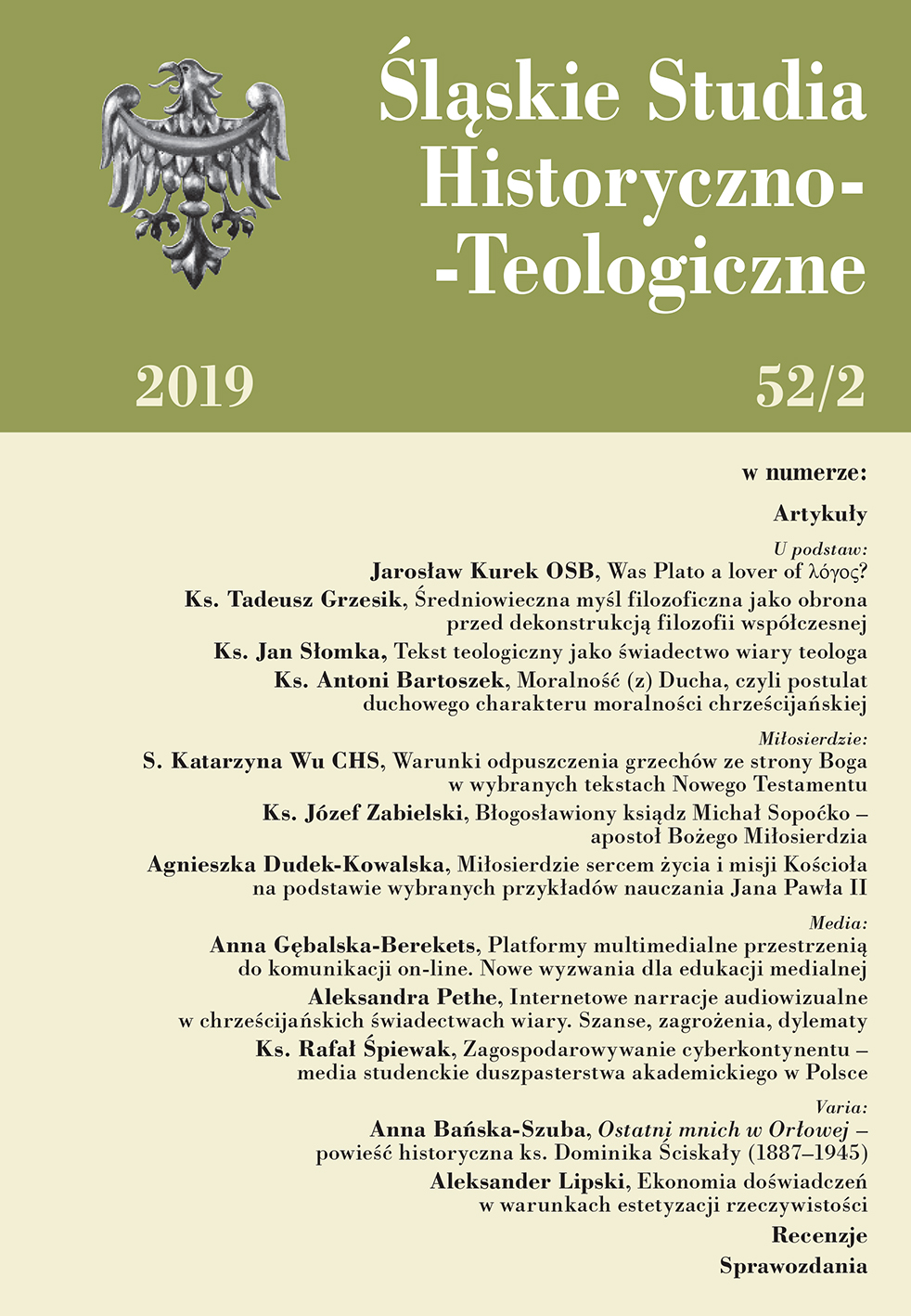
This paper focuses on the concept of logos in the writings of Plato. After preliminary methodological considerations, it proceeds to attempt a provisional definition of the term. It then examines the philosopher’s capacity to be philologos. This ability, the paper shows, is closely connected with the philosophical dimension of music. This eventually leads to a novel and complex definition of logos. Contextualised in the historical event of Socrates’ trial as recounted in the Apology, it argues for the capital importance of the dialectical search for logos in Plato’s philosophical work.
The process of deconstruction of philosophy initiated by post-modern thinkers is aimed not only at philosophy, but also at European culture and the role philosophy has hitherto played in its formation. It is a process which Roger Scruton calls “the devil’s work”, one intending to eliminate the influence of Christian culture on present day society. The paper has four parts. In the first, the author introduces the problem and indicates certain instances illustrating how the present state of contemporary philosophy was reached by the disregard and culpable ignorance of mediaeval philosophy by those who are professed Christians. (Roman Ingarden’s example). Anselm of Canterbury is the counter-example given as one whose adherence to the Catholic faith inspired him not only to seek a more meaningful understanding of what he professed by faith, but also to make use of free philosophical speculation and Christian doctrine in order to contemplate reality and make philosophy more meaningful. The quest for truth, pursued by Anselm in the Middle Ages, is re-enacted in modern times by John Henry Newman and Edith Stein: two converts to the Roman Catholic Church. The second part considers Roger Scruton’s attempt to denounce the evil of Jacques Derrida’s idea of the deconstruction of philosophy, taking also into account the role nihilism and relativism play in this procedure. In the third part, the author of the paper refers to the thought of G.K. Chesterton and contemporary Polish philosophers: J.M. Bocheński, S. Swieżawski, B. Skarga, who by their appreciation of metaphysics, the Christian heritage of Europe and mediaeval thought, point out the benefit of these, not only for the human spirit, but also for the safeguarding of philosophy from the menace of disintegration present in the global ideology of political correctness and the ideas of post-modern “quasi-philosophers”. Lastly, in the fourth part, Ludwig Wittgenstein's thought and example are considered as one whose radicalism is aimed at philosophy and religion, one endowed with a sense of mission as regards saving philosophy and religion from absurdities which hinder the proper functioning of these two pillars of culture. The author concludes by suggesting that a “back to basics and common sense” approach is necessary, if we are not to succumb to the “devil’s work” of irrationalism. He also advocates the reading of philosophical classical texts both ancient and mediaeval, especially Boethius’ The Consolation of Philosophy and Chesterton’s Orthodoxy.
The theological text should be a testimony of theologian’s faith. The article considers three possible ways of such a certificate. First of all, the text should meet the criterion of orthodoxy. He must therefore respect God’s revelation transmitted in the Scriptures and kept in Tradition. According to the teaching of the Catholic Church, the Church’s Magisterium gives an authoritative interpretation of Tradition. However, both the interpretation of the Holy Scriptures and the reading of Traditions require theological skill. Otherwise you risk falling into fundamentalism. This fundamentalism in relation to the Magisterium of the Church is often expressed in two opposing ways: either in avoiding references or in excessive reference to the statements of the Magisterium. The second potential way of testimony of faith is by referring to personal testimony of faith, your experiences. Such “naive” direct testimony should not take place in a theological text. This assertion is supported by two arguments: the requirement of criticism that could not be met by one’s personal testimony and the difference between spoken and written words. However - and this is the third way of presence - the theological text should be permeated with the spirit of faith, that is, grow out of the personal experience of faith, but not through “witnessing” but through internal fidelity to this experience. The article attempts to describe the experience of faith based on the philosophy of Levinas.
The article claims that a proper understanding and living Christian morality calls for taking into account its spiritual character. A deeper reflection on morality is a task for all Christians. However, moral theology has a special challenge in this respect. Therefore the presented analyzes emphasize the concern for the proper shape of moral theology itself. To explain the need for a deep spiritual understanding of Christian morality we first needed to answer questions concerning the relationship between morality and spirituality, the influence of the Holy Spirit on shaping Christian morality, and finally the relationship between moral theology and other theological disciplines, especially theology of spirituality.
The article analyses a few texts of the New Testament (Matthew 9.1-8, Mark 2.1-12, Luke 5.17-26, Jacob 5.13-18, 1John 1.8-2.2) that describe certain conditions that allow man to receive forgiveness of sins from God’s side. They are: faith, prayer rooted in faith, anointment in the name of the Lord by priests and confession of sins. What can be concluded from the texts in question is that God is ready to forgive man sins, but what is required is human cooperation. The said texts cast light on certain statements from the New Testament in which forgiveness of sins is accompanied by no conditions and help to understand that God’s mercy call for certain conditions on the sinner’s side.
The article describes participation of blessed father Michał Sopoćko in development of the cult of Divine Marcy. It also deals with the visions received by sister Faustina, forms of revealed worship as well as people involved in development of the cult. The author deals with theological legitimacy of this cult and its various forms.
The purpose of the presented article is the synthesis combined with the analysis of these examples of teaching of Pope John Paul II that show the issue of mercy as the heart of faith and mission of the Church. Its aim is to present the topicality of the requirement of the Pope to make proclamation and practice of mercy the mission of the Church and – as a further consequence – the base of human relationships. In the first two parts of the article the author elaborates the faith and the testimony of the Church and within this part analyzes mercy as the subject of the experience and the message of the Church and elaborates the form of the testimony. Within the part dedicated to calling for mercy the author shows first the needs and problems of the contemporary world and then presents mercy as the basic answer for them. The author refers finally to the problem of the constant effort of conversion as the manifestation of mercy and the guarantor of the realization of the requirements of mercy. The presented analysis leads to the conclusion that the topic of mercy in the teaching of Pope John Paul II constitutes the constant and current reference and it should be realized by the faith and practice of mercy in the life and the mission of the Church.
Multimedia combines many forms of communication. Media convergence and their diversity exercise significant influence on the perception of recipients. The article deals with topics related to multimedia platforms as a tool for online communication. Changes taking place in areas of human activity on the web require a proper educational approach.
Contemporary communication environment is shaped by the mass media culture. The digital world offers various communication techniques. This determines the search for new, effective forms of expression. The problem also applies to religion. The author asks about the possibility of using the potential of cyberspace in effectively fulfilling the mission of evangelization in order to effectively reach sacred content with a modern recipient. The article analyzes a specific genre of religious expression which is the testimony of faith online. The article also describes the evolution of the species and indicates the tendencies to professionalize in this area.
Benedict XVI called the Internet the “new digital arena” and “digital continent”, at the same time assigning urgent tasks to the Church in order to properly use this space and penetrate the spirit of the Gospel. He realized that “The digital world is not a parallel or purely virtual world, but for many people, especially the youngest, it is part of everyday reality.” His thought was developed and deepened by Pope Francis in the exhortation Christus vivit. He emphasized that since people not only communicate in this space, but treat it as their living environment, there is an urgent need to send cyber missionaries. Their task is to preach the message of Jesus Christ to young people and to contribute to building the community of the Church. An extremely interesting field to examine how the teaching of recent popes was received is the media of academic pastoral care in Poland. They represent the special case of academic media. The use of new communication technologies still remains a pastoral challenge, especially for young people.
The article contains a historical and literary analysis of the novel The last monk in Orłowa which was written by the Cieszyn clergyman – Dominik Ściskała (1887–1945) and published in Cieszyn by the publishing house of Blessed Jan Sarkander in 1924. The author was engaged in the dispute over the Polish-Czech border in 1919–1920 on behalf of the Union of Silesian Catholics. After losing the fight for the Zaolzie lands he created a historical novel ‘to encourage hearts’ for contemporary compatriots from the Olza River. This article is an attempt to read the novel as a regional “Cieszyn Deluge”. For this purpose, the author presents not only relationships with Sienkiewicz’s work, but also similarities and differences in: the creation of the represented world, the narrative, the construction of time, the use of historical material, and the construction of a real and fictional plan. She also discovers the historiosophical thought which is contained in the novel. She shows the Reformation as an evil that caused a breakdown of unity in faith in the past, and t he division of the native land in the present day. The author also indicates what the thought to give “encouragement to compatriots” is based on, despite the tragic finale of the novel. The analysis and interpretation of the novel by Fr. Ściskała is the first historical and literary attempt of this kind because no one has ever dealt with it before.
Experience economy (impressions, survival, emotions, etc.) is a part of a wider syndrome of phenomena: in the cultural dimension it is a part of the aestheticization (culturalization) of reality, in the economic dimension it is a component of cognitive capitalism. The aestheticization of reality consists in replacing the original instrumental-practical function with a semiotic-symbolic function. Aestheticization manifests itself in the museification and theatralization of instrumental-practical objects and activities of everyday life. Aestheticization leads to the expansion of the scope of culture (iconosphere), which from a separate domain of the social world becomes its ubiquitous feature (socio-cultural unity). In cognitive capitalism, experience economy is part of the dematerialization of work and production.



 English
 Język Polski
 https://doi.org/10.31261/SSHT.2019.52.2.01