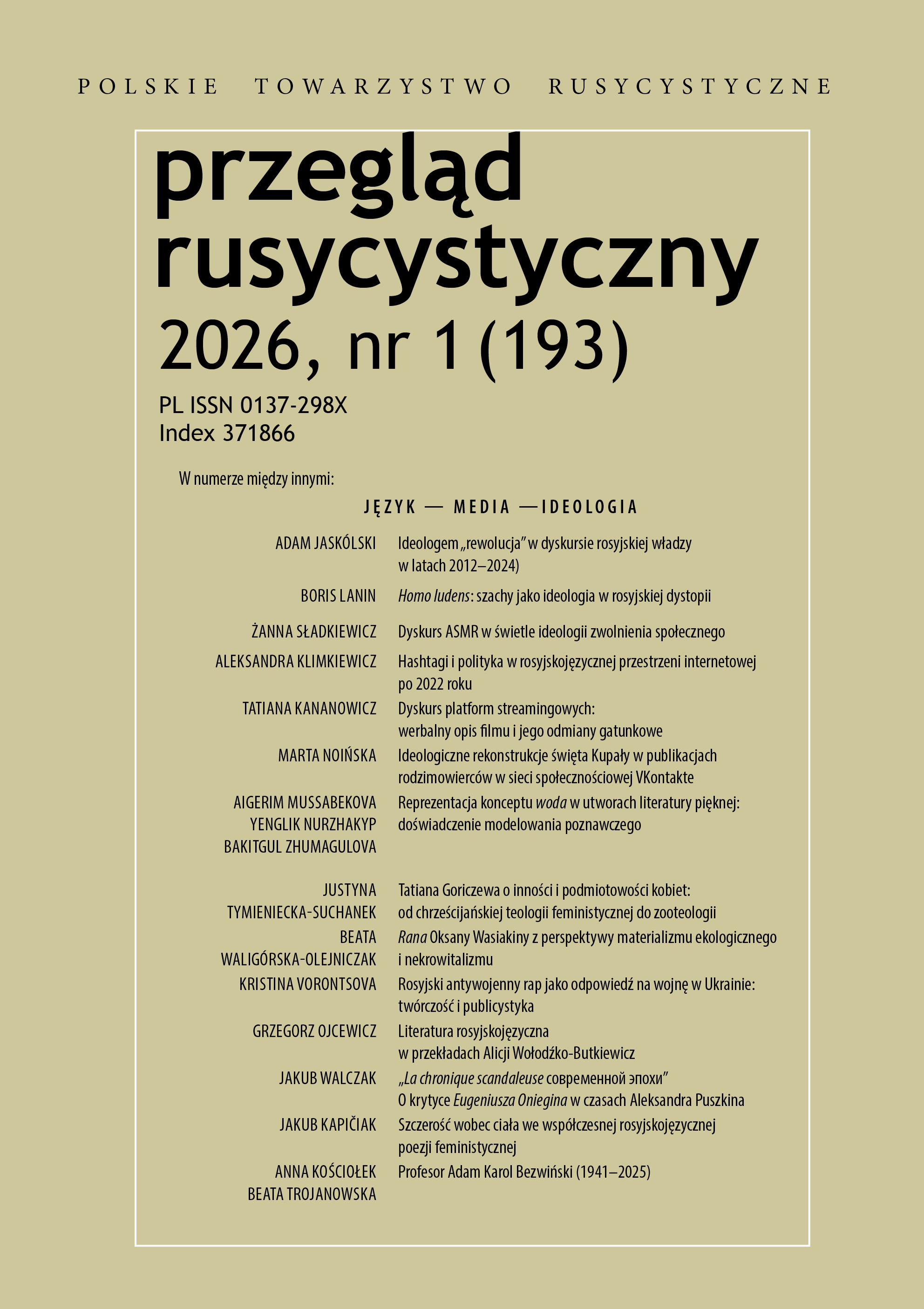
The main aim of this article is to analyse the linguistic uses of the ideologeme ‘revolution’ in the discourse of the Russian authorities, as well as in the media subordinate to them and the Russian Orthodox Church, which cooperates closely with the state, in the years 2012-2024. Ideologemes play an important role in ideological discourse because they are easy to remember and allow for an unambiguous distinction between US and THEM. The analysis showed that currently, in the discourse of the Russian authorities, the ideologeme ‘revolution’ has clearly negative connotations, which can probably be explained by the Kremlin's fear of a so-called colour revolution in Russia and, consequently, its efforts to prevent the democratisation of Russia and maintain an authoritarian system of government. In the examined statements, the concept of ‘revolution’ is primarily associated with such concepts as destruction (destructive force), civil war, internal conflict, social division, the collapse of statehood and the economy, chaos, loss of stability, illegality, lawlessness, and foreign interference. In the discourse of the Russian authorities, revolution is presented as an undesirable and dangerous phenomenon, as an inappropriate way of bringing about change.
This article analyzes Alexey Konakov’s novel Tabiya Thirty-Two through the lens of Johan Huizinga’s concept of homo ludens and the genre conventions of dystopian literature. Set in post-crisis Russia in the year 2080, the novel imagines a society rebuilt around chess as the cornerstone of cultural identity, a tool of state ideology, and a means of social control. The author explores how the image of the “playing human” — homo ludens — is transformed under a chess-centric dictatorship. Chess is reinterpreted not as a sport, but as a humanities-based discipline where academic and cultural contributions are valued above competitive success. The study draws on a wide theoretical framework, including Michel Foucault’s biopolitics, Pierre Bourdieu’s theory of cultural capital, Sigmund Freud’s notion of sublimation, and Antonio Gramsci’s theory of cultural hegemony. The condemnation of Fischer Random Chess (Chess960) is interpreted as a defense of orthodox cultural values against subversive thought. The novel demonstrates how play may serve as an instrument of discipline, sublimation, and ideological regulation while retaining the potential for critical thought and personal tragedy. This analysis underscores the uniqueness of Tabiya Thirty-Two as a work that fuses philosophical parable, dystopia, and cultural metaphor, making it a significant contribution to contemporary Russian literature.
This article explores the sociocultural trend toward social slowdown and relaxation and examines ASMR discourse as a media manifestation of this trend. ASMR emerged as a media and sociocultural phenomenon, made possible by the development of digital platforms, primarily YouTube. It is interpreted as a multimodal, multisensory, convergent media genre that employs sound and image to create a pleasant, immersive environment appreciated by its audience. The article presents the genre and discursive specifics of ASMR.
The text examines the functions and meanings of hashtags within the Russian and Russian-language digital space. Hashtags are interpreted ascommunicative tools, symbolic cultural signs, and mechanisms for constructing and delegitimizing authority. The analysis is grounded insemiotic, pragmatic, and discursive perspectives, presenting the hashtag as a multidiscursive form. Examples of Russian-language hashtagsdemonstrate their affective, performative, metadiscursive, and mobilizing functions.
Streaming platforms actively employ film summaries in the promotion of their content. According to a number of criteria—structural, cognitive, and stylistic—the genre is divided into several subgenres, which are recognized by both developers and users as distinct textual units. These units can be placed at different levels of hypertext and combined in various ways into larger genre collections. This distinctiveness has called for specific naming and has ensured the recognizability of these units within the already established genres of screenwriting, marketing, and publishing – the logline, synopsis, tagline, and blurb. The article examines the processes associated with the incorporation of these genre formations into the discursive space of streaming platforms.
The article examines VKontakte publications by Slavic Native Faith practitioners concerning the Kupala festival. The holiday’s ideological reconstruction involves restoring ancestral worldviews and maintaining a connection with the sacred. Rather than a folk entertainment, Kupala is framed as a religious ritual that revives ancestral traditions in opposition to Christian reinterpretations. Visual symbols such as ritual fires, traditional costumes, sacred sites, and deities help construct an alternative religious discourse distinct from Christianity. Kupala thus becomes a tool of ideological expression, with social media serving as an important space for transmitting and consolidating this reconstructed tradition.
С позиции эколингвистики репрезентация концепта вода рассматривается не только как отражение природной реалии, но и как многомерный ментальный конструкт, наделённый значительной аксиологической нагрузкой. В художественном дискурсе данный концепт функционирует как культурный концепт и идеологема, отражающая специфику русской языковой картины мира и её ценностных координат. В статье представлены современная и советская когнитивная модели концепта вода в виде кейсов. В результате исследования выявляется, что концепт вода в художественном дискурсе функционирует не только как природный элемент, но и как важнейший концепт ментального и идеологического порядка, способный моделировать отношения между человеком, природой и социумом, формировать экологическое сознание и экологическое поведение в соответствии с запросами общества.
The article presents Tatiana Goricheva’s Christian feministic views, which the Russian philosopher and theologian lays up in her work Hiob’s Daughters. Christianity and feminism (1992). The author of the paper also notes the evolution of Goricheva's thought, for which the struggle for women's rights became the starting point for her interest in animal protection. Goricheva’s intellectual and feminist activity made way for her to zootheology. Philosopher’s attitude situates itself in contemporary search for deep connections between the fight for women’s rights and fight for animals’ rights.
This paper focuses on the interpretation of Oksana Vasyakina’s novel Wound. The analysis is methodologically based on Ewa Domanska’s original concept of necros. In the process of close reading the Russian writer’s text, the author creatively adapts Domanska’s scholarly observations, which are presented in her monograph Necros: An Introduction to the Ontology of the Dead Body. This approach addresses three thematic areas that correspond with three main parts of the paper, i.e. the agency of the dead body, the cyclical nature of life and the taboo of death, and the problem of space. Taking advantage of the concept of necros in the process of interpretation allows the author to treat the literary text as a potential “rescue history”, to consider the dead body from the point of view of ecological materialism, and to rethink dominant discourse on death. In the conclusion, the author notes that by referring to intimate memories, Vasyakina domesticates the topic of death and changes its previous taboo status, thereby linking the novel with the ideas associated with the geological and postsecular turns. The tangibility of textures and the materiality of descriptions found in the Russian novel allow us to imagine the past differently and understand culture as the cultivation, care and protection of natural resources.
Since Russia’s full-scale invasion of Ukraine in 2022, Russian Rap has become one of the most powerful tools of artistic resistance, with anti-war songs emerging as both cultural protest and a new form of non-fiction narrative. Among the most notable voices is the Kasta band and one of its members Vladi with a solo project, whose works blend elements of satire, lyrical self-expression, and journalistic testimony. These songs not only articulate personal perspectives on the war but also document war crimes committed by Putin’s regime, turning rap lyrics into vehicles of cultural memory and protest journalism. The purpose of this study is to examine Russian anti-war rap after 2022 as a hybrid phenomenon at the intersection of art and reportage. The research addresses key questions: How do artists like members of Kasta use satire and lyrical innovation to oppose the war? In what ways do their songs function as non-fiction, documenting social reality under conditions of censorship? How does their work influence public perception of the war in both Russia and abroad? The analysis will focus on the lyrics of Kasta’s album “Новинкизарубежного рэпа” (2024) and Vladi’s “Длится февраль” (2022), supplemented by interviews and critical reviews. The method of close reading will be combined with discourse analysis of media reactions and social networks. By analyzing the case of Russian Rap, this research sheds light on the potential of music to serve simultaneously as art and as a form of political journalism. It also highlights the broader role of cultural resistance in times of war and repression.
The author addresses the issue of Russian-language fiction and non-fiction literature with literary merits in Polish translations by Alicja Wołodźko-Butkiewicz. In order to do so, the author carries out a quantitative and qualitative analysis of her 1977-2014 translation output. Translations – in the strict sense of the word – of both fiction and documentary texts with literary value were selected herein. The author also points to the translator’s activities beyond translation itself, which involved selecting works by Russian and Soviet-era authors with the intention of creating anthologies, as well as writing introductions and afterwords to these collections. Looking at overall academic, literary and critique achievements of Alicja Wołodźko-Butkiewicz, her translation works were a constant element of her research activity, though they were not the main focus of her professional life.
The purpose of the article: „War from a civilian perspective based on the works The Language of War by Oleksandr Myched and Last Witnesses by Svetlana Alexievich” is to present a picture of war as seen through the eyes of a civilian and its impact on the physical and spiritual aspects of human life. The aim of this article is to explore the perspective of an innocent participant and witness of wartime experiences, who undergoes an involuntary bodily and spiritual transformation as a result of extreme events. The protagonist's metamorphosis is shown as a process of slow, irreversible transformation of the individual under the influence of warfare. The reference to the figure of the biblical Job gives the story a deep existential dimension – both protagonists are full of internal conflicts, doubt and rebel, but do not lose faith. The article draws attention to the universalism of the message and its biblical context – behind the eponymous Job there is every innocent victim of Russia's invasion of Ukraine, which makes the reportage show the suffering of the individual in a broader philosophical and anthropological dimension. The article employs the methods of literary and cultural comparativism, hermeneutics, as well as the method of philological analysis.
This article examines the early critical reception of Alexander Pushkin’s Eugene Onegin, focusing on responses from the 1820s and 1830s, when successive chapters of the poem were published. While later interpretations shaped the canonical understanding of the novel in verse, contemporary criticism differed significantly in both tone and content. The study reconstructs the heated debates in the literary journals of Pushkin’s time, where the poem was alternately praised as a groundbreaking work or dismissed as trivial and lacking in “great ideas.” Early critics emphasized questions of national character, genre, and the suitability of subject matter for poetry, often contrasting Pushkin’s realism with Byron’s romanticism. The article argues that these first reactions, frequently neglected in literary historiography, not only reveal the dynamics of early nineteenth-century Russian literary polemics but also highlight the gap between the immediate reception of Eugene Onegin and its later recognition as a foundational text of Russian literature.
In 1995, Jeanne Martha Perreault developed the term “a feminist autography” to describe the interplay of subjectivity, writing, and community in feminist literary works. This study employs it exploring the role of the body and corporeality in contemporary Russophone feminist poetry. Because such poetry is preoccupied with the issue of mediating the female experience through a subjective lens, the paper is mainly focused on how the rhetoric of sincerity is employed in the studied works. The applied understanding of sincerity is based on a simple definition of the term by Lionel Trilling (1972) as “a congruence between avowal and actual feeling,” embedded in the distinction between the inner subjective world and its outer public representation. Drawing on this notion, the study tries to develop a more nuanced understanding of sincerity and its rhetoric by closely analyzing the following poetical texts: Galina Rymbu’s poem Moia vagina (2020), Oksana Vasyakina’s poem shto ia znaiu o nasilii (2019), Lida Yusupova’s poem Mateiuk (2016), and selected fragments from the book Prigovory (2020), selected short poems by Darya Serenko and Yegana Dzhabbarova, and the lyric cycle Devochki bez odezhdy (2020) by Maria Stepanova.


 10.31261/pr


 Język Polski
 Русский
 English