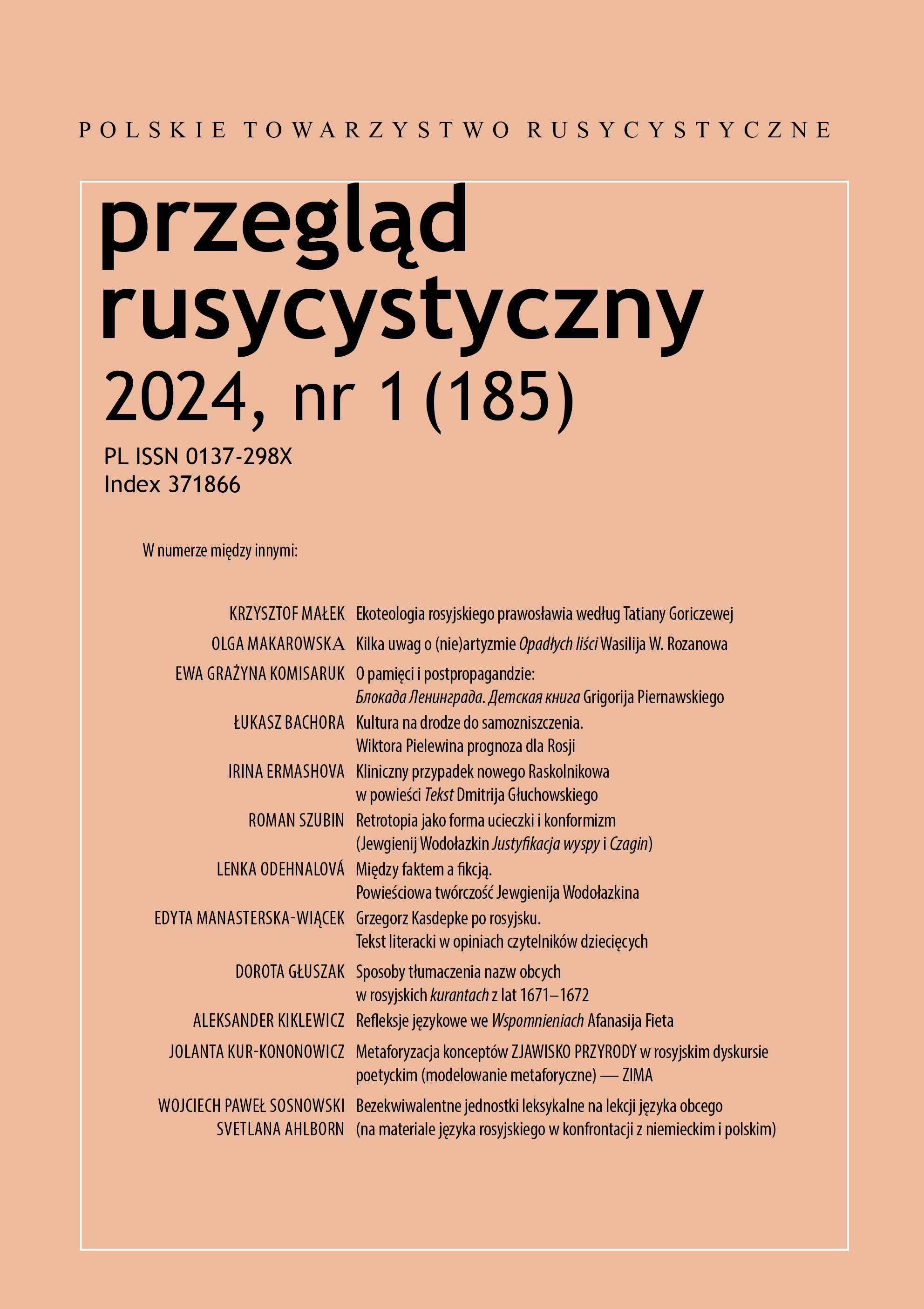
Consideration of the human-nature relationship goes beyond the natural and social sciences. All creatures have an equal right to exist. According to Orthodox ecotheology, it is the Absolute who called entities into existence and gave them certain rights. The aim of this article is to analyse the significance of the environment in Orthodoxy, using the work of Russian philosopher and theologian Tatiana Goricheva as an example. Referring, among other things, to the philosophical-theological and hagiographical reflections contained in the works of the author of Holy Animals, the status of the natural environment in Orthodoxy and its role in the history of salvation is discussed, and a consideration of Christian biocentrism and anthropocentrism in Orthodoxy is undertaken.
The article focuses on determining if V. Rozanov's "Fallen Leaves" belongs to literary texts. The article defines the category of the artistic text and identifies its criteria, which are typical for all literary texts. Based on these criteria, it is confirmed that Rozanov's work does not belong to literary texts, although it contains some of their features. For further confirmation, Rozanov's text is examined through the prism of several other criteria, including the textuality criteria of Beaugrande and Dressler, along with an analysis of linguistic and stylistic means used by Rozanov. The carried out analysis confirmed the originality of Rozanov's "Fallen leaves".
The article discusses the book The Leningrad Blockade. Children's Book (2019) by Grigory Piernavsky. It analyses the structure, content organization, bricolage form and, most importantly, the way of talking about the siege of the city proposed by the author. The analysis shows that the content of the discussed publication fits closely into the official discourse of Russian historical policy, referring to the Great Patriotic War. Comments on the book were related to the functioning of collective memory, propaganda and postpropaganda.
The article is an attempt to apply the tools of analytical psychology in the study of contemporary Russian literature. Continuing his research of Victor Pelevin's early prose, presented in the 1 (173) issue of "Russian Studies Review" (2021), author proposes a comprehensive reading of four novels published between 2006 and 2013: Empire V, T., S.N.U.F.F. and Batman-Apollo. From the works of the Russian postmodernist emerges a coherent and even prophetic (as it may seem in retrospect) picture of the gradual decline of Russian culture as a consequence of interrupted process of individuation. This key category in the concept created by C.G. Jung is applied to specific characters and groups presented in Pelevin's novels, but also to a specific social reality. Such perspective is justified by the attitude of the writer himself, who describes the process of creating literary worlds as a way of externalizing mental reality, both in its individual and – what is especially important – the collective aspect. Thus contents of his works can be treated as a manifestation of the Russian collective unconscious and interpreted in terms of C. G. Jung’s analytical psychology.
This article is devoted to the novel TEXT by Dmitry Glukhovsky and is especially focused on its reading in an interdisciplinary manner. It is a kind of attempt to compare evaluative readings and judgments, which mainly affect the intertextuality of the novel (a parallel with Raskolnikov), the modern realities of Russia and the problems of technical evolution. This analysis considers the artistic embodiment of the PSTR in modern prose, in the Text, and contributes to the relationship between literature and medical humanities.
The article considers several works by Evgeny Vodolazkin of recent years, in which there is a convergence of medieval techniques and modern literary trends. All of them are united by a global setting for retrotopia, in the understanding of Sigmund Bauman, namely: an escape into the past, a search for the limit of originality, a sense of unity, myth-making. Based on the article Literature: the future is in the past (2019) and the novel Justification of the Island (2020), the study of the topic of anachronisms as a form of aberration of consciousness and retrospective thinking, characteristic of the Middle Ages, is carried out. The novel Chagin (2022) explores the myth-making attitudes associated with the method of retrospection, in which memory is distorted, consciousness is restructured, and mistakes and moral fall are justified. Such concepts and categories as reality, history, memory, responsibility, deed, repentance are completely withdrawn from circulation. As a conclusion, one can postulate a paradoxical annulment of the theme of memory, declared at the beginning of Chagin's novel, and its replacement with the theme of oblivion and memory distorted in retrospection, symbolically represented by the rivers Lethe and Eunoia.
The paper On a Borderline between Fact and Fiction. Literary Output of Eugene Vodolazkin concentrates on two works of the contemporary Russian writer Eugene Vodolazkin (born 1964) that met with the highest response in the Czech milieu, i.e. Laurus (2012) and The Aviator (2015). Using the methods of genre analysis and comparison, the essay examines their specific genre features and a borderline made up by mediaeval historical facts, traits of a chronicle, biographical novel, hagiography and legend in the case of Laurus and, in the case of The Aviator, the genre of a diary achieved by placing the main character's recollections into the diary records and by facts connected with Saint Petersburg.
The work of Grzegorz Kasdepke, a Polish writer who is extremely popular among younger readers, has been recognized both in the country and abroad, as evidenced by translations of his works into other languages, including Russian. The purpose of this study is to examine to what extent the nuanced non-identity of the message affects reader reception. The assessment of how children evaluate messages from two different texts was established based on surveys conducted among 110 respondents. The results show that, for a younger audience, the length of the text, ease of comprehension, the detail of the message, and the linguistic form of the text are significant. Almost all respondents expressed sensitivity to the wording of the book title, and some of them were able to identify – beyond subjective evaluation – conditions conducive to the effective circulation of the work.
This article is a continuation of research on the language of Vesti-Kuranty – relics of Russian literature within the genre of journalism. The investigation is aimed at indicating techniques of translating used in Posolski Prikaz and was carried out on nouns – common and proper names (toponyms and antroponyms). The sources are texts from the years 1671–1672 translated into Russian from German and Dutch.
The subject of the article is the linguistic analysis of language reflections in two volumes of memoirs of the outstanding Russian poet Afanasy Afanasyevich Fet (1820-1892), published in 1890. Language reflection is understood as a text fragment, the content of which is directly related to the elements of the language system, language behavior or precedence texts as products of language activity. The author distinguishes several types of language reflections: references and textual reminiscences, speech characteristics of persons and events, linguistic remarks on lexical, pragmatic, phonetic and other speech characteristics, description of verbal (poetic) creativity, as well as remarks on interlingual communication. The nature of Fet’s language reflections is interpreted from the point of view of the poet’s worldview and his personality.
The aim of the article is to analyze the methods of metaphorizing the concept of NATURE PHENOMENON that characterize WINTER in the Russian poetic discourse. The following concepts are subject to description: SNOW, BLIZZARD (SNOWFLAKE), FROST, HOARFROST, ICE, SNOWDRIFT, HAIL, WINTER (CНЕГ, ВЬЮГА, ПУРГА, МЕТЕЛЬ, БУРАН, МОРОЗ, ИНЕЙ, ЛЁД, СУГРОБ, ГРАД, ЗИМА). The subject of the analysis is the so far not studied specificity (modeling) of combinatorics of metaphorical patterns in poetic texts in semantic and cognitive terms. The material for analysis consists of 172 metaphorical expressions (conceptual metaphors). The source domain was used as the basis for metaphorical modeling, and therefore the division of conceptual metaphors into anthropomorphic, zoomorphic, phytomorphic, naturomorphic and artifactual (object) metaphors was used. The result of the article is the distinction of mono- and polymetaphores containing an incorporation and correlation metaphorical model (single- and different-type binary and tertiary models).
Any natural language contains several lexical units that do not have equivalents in other language systems. In certain languages, we can observe linguistic units that have a cultural background, as they are associated with the history, customs and experience of a given people and their linguistic imagery of the world. These units are especially noticeable when we compare any languages, compile bilingual and multilingual phraseological or explanatory dictionaries, teach foreign languages or do translation work. In our study, using Russian-language educational materials, language intuition and corpus data, we collected, analyzed, and classified examples of lingua-specific words and expressions for which due to linguistic realities there are non-translational communicative correlates in German and Polish. Our observations could be of interest not only for researchers and teachers but also for foreign language learners.


 10.31261/pr


 Język Polski
 Русский
 English