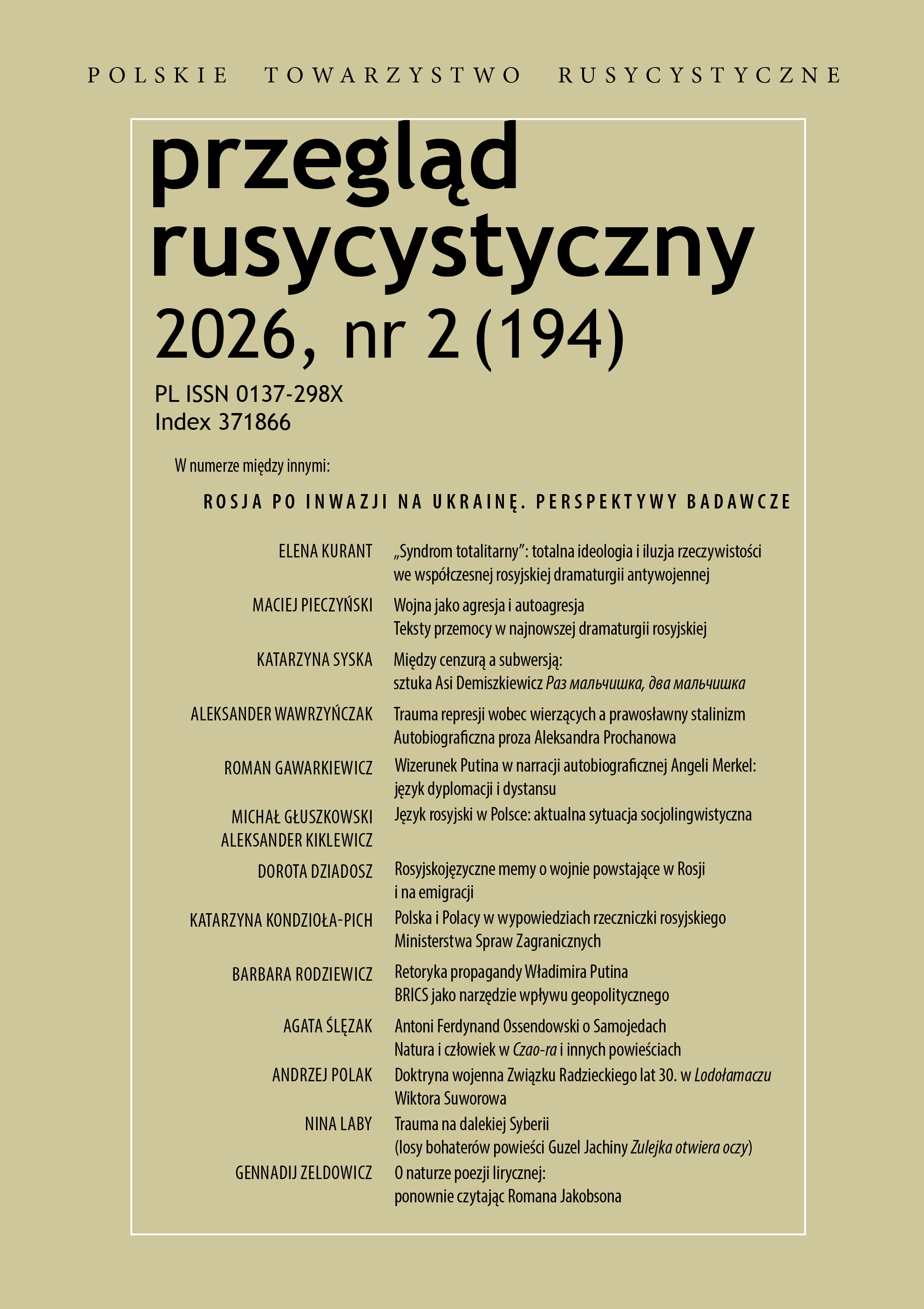
Contemporary Russian-language drama seeks not only to document the painful fractures of the era, but also to reflect upon them through living dialogue and emotional engagement. Authorial voice approaches confession or testimony, transforming the play into collective experience. Plays centered on voices from contemporary Russia—victims of total terror and totalitarian propaganda. These are characters with traumatized consciousness, whose perception mirrors the illusory reality imposed by the repressive state. Through analysis of documentary anti-war plays from the 2023 Lyubimovka festival, we attempt to identify the ways in which traumatic experience, dehumanization of the individual, and social collapse within a totalitarian state are conveyed.
The Russian invasion of Ukraine has been reflected in the work of Russian playwrights. Both anti-war plays created as part of the Lubimovka festival and pro-war propaganda texts commissioned by the state authorities address the issue of violence. In this article, I distinguish two categories of violent texts: images of aggression directed against civilians and images of self-aggression, of which Russians themselves are victims
The fairy-tale drama Размальчишка, двамальчишка (2023, Once a Boy, Twice a Boy) by Asya Demishkevych exemplifies Russian anti-war literature produced under conditions of dispersed censorship. The analysis focuses on the dual function of the folkloric genre: as a subversive device of Aesopian language and as a tool for disciplining and subordinating the characters. A similar ambivalence characterizes the author’s creative strategies, which navigate between the poles of compromise and risk.
The article examines two autobiographical novels by Aleksandr Prokhanov, a prominent Russian writer and journalist widely regarded as one of the leading ideologues of Russian imperialism during Vladimir Putin’s presidency. By exploring the author’s early life and formative experiences, these works provide a basis for reconstructing the foundations of his contemporary worldview, commonly described as Orthodox Stalinism. The analysis demonstrates that Prokhanov’s ideological formation was shaped by two principal influences: first, his ancestors’ involvement in Evangelical Baptist and Molokan communities; and second, the cult of Stalin that dominated the sociopolitical environment of his youth. The quasi-religious character of Prokhanov’s ideological beliefs contributes to the perpetuation of a distorted interpretation of the Stalinist period and fosters imperial resentment within Russian society.
This article aims to reconstruct the image of Vladimir Putin as retained in the memory of Angela Merkel and described by her in the autobiography Freiheit. Erinnerungen 1954–2021. The study draws on an analysis of recurring lexical, metaphorical, and evaluative elements in the narrative, which reveal how the author conceptualizes key categories such as power, communication strategies, geopolitics, and the historical identity of the Russian leader. Based on this analysis, a semantic profile of Putin is constructed, highlighting dominant negotiation practices, mechanisms of interpersonal control, and symbolic enactments in diplomatic interactions. A significant aspect of the study is the role of the narrator’s affectivity: her emotional responses function as a cognitive tool, enabling the interpretation of intentions and the management of asymmetric political relations. The findings suggest that the former German chancellor’s autobiography constitutes a valuable source for the study of contemporary diplomatic mechanisms, where communication, power, and emotions collectively shape decision-making under conditions of pressure and asymmetry.
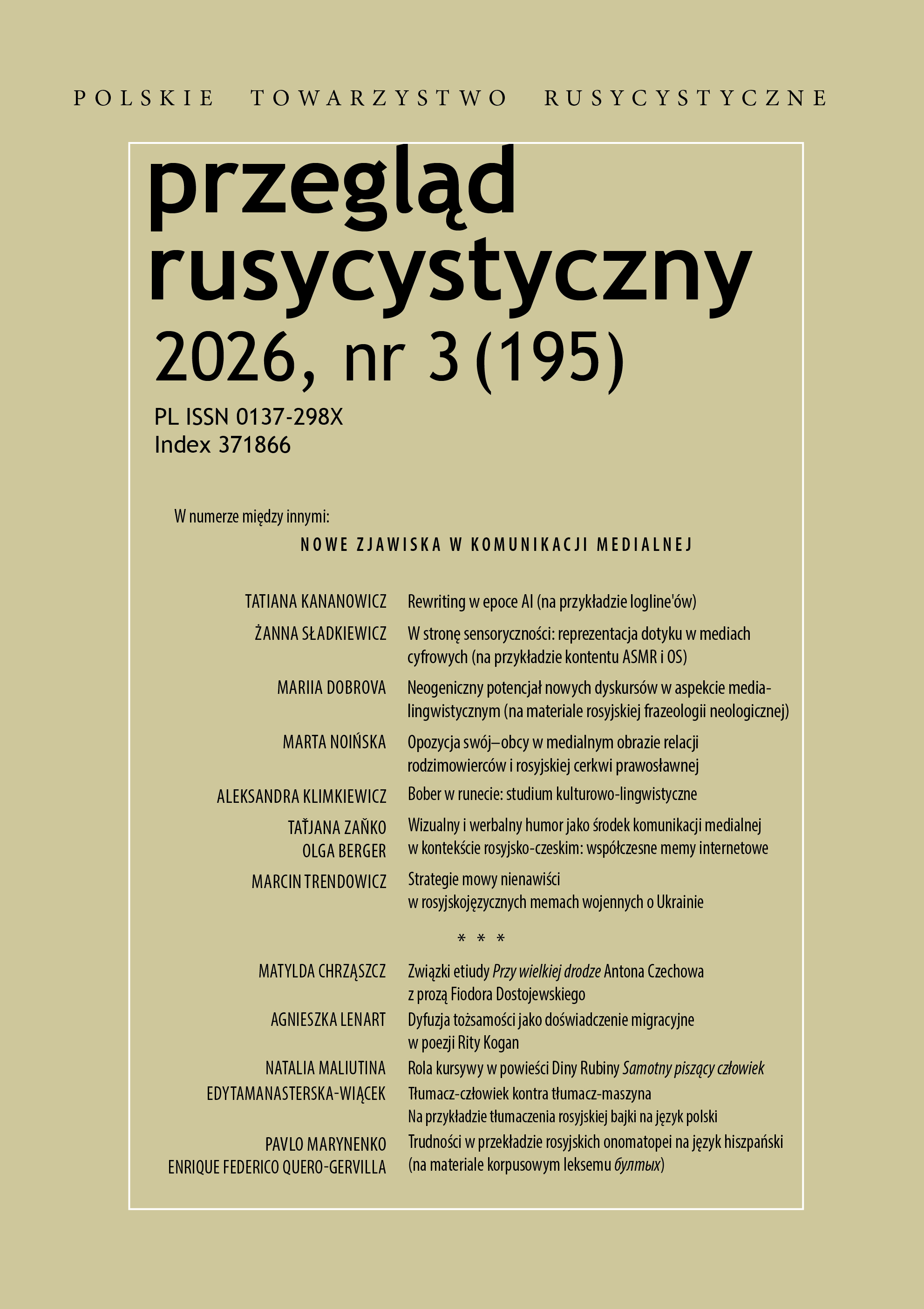
The aim of this article is to present the role of Russian in the Polish linguistic sphere and the changes in its position over recent decades. In the late 1980s, it was the most widely known foreign language among Poles, but political transformation, socio-economic changes, and a pro-Western orientation in foreign policy have led to a gradual decline in its role. This has been influenced, among other things, by changes in education, where Russian has gone from being the first and mandatory foreign language to one of several optional, giving way not only to English but also to other Western European languages. Russian is spoken in Poland not only by Poles and the Russian minority but primarily by immigrants from the former USSR, primarily Ukraine and Belarus. The article discusses changes in the use of Russian, attitudes towards it, and its current functioning in the press, education, social media, and various social and national groups.
This article compares Russian-language internet memes about Russia’s war in Ukraine produced both within the Russian Federation and within the Russian-speaking diaspora in Western countries. Using a qualitative semiotic and contextual approach, the analysis highlights different strategies of interpreting and commenting on the conflict depending on the socio-political context. Memes circulating in Russia more often rely on irony, humor, and allusion, operating within the constraints of the public discourse, whereas diaspora memes more frequently take the form of symbolic criticism, mocking propaganda and emphasizing the social and moral consequences of the war. The article argues that memes constitute an important tool in shaping attitudes toward war, power, and identity, and reveal divisions within the Russian-speaking community.
This article aims to identify and analyse the forms of argumentation through which the image of Poland is constructed in the official communications of the Ministry of Foreign Affairs of the Russian Federation. Analysis of the empirical material reveals the systematic deployment of propaganda techniques, including the demonization of opponents, manipulation of historical narratives, deprecatory strategies grounded in irony and colloquialization, as well as the dissemination of disinformation. Particular attention is given to key lexical items and persuasive linguistic devices that frame the audience’s interpretation in specific ways. The findings demonstrate that the examined statements do not function as neutral institutional communication; rather, they serve as instruments for advancing the contemporary political and ideological objectives of the Russian Federation.
The subject of this article is the instrumentalization of language as a tool for creating an alternative ontological reality in Vladimir Putin’s speeches at BRICS summits (2022–2025). Using critical discourse analysis and the rhetorical triad (ethos, pathos, logos), the study reconstructs topoi of systemic threat, justice, and economic determinism, which serve to legitimize Russia’s revisionist policy. The analysis demonstrates that through deliberate redefinition of concepts, the speaker constructs a narrative that consolidates Global South states around Russia’s strategic objectives. The findings indicate that Russian diplomatic communication has become an autonomous force capable of shaping international realities and transforming the existing geopolitical order toward a multipolar system.
The article examines the customs of Samoyedic tribes as depicted from the perspective of a European traveller in 1920s Siberia, observing indigenous communities in their natural environment. It analyses the lives of the characters in the novel Czao-Ra, emphasizing the cyclical nature of their behaviour, their close relationship with nature, and their subordination to its laws. The discussion is contextualized by reference to Ossendowski’s other works, as well as to accounts by Siberian exiles (notably Wacław Sieroszewski on the Yakuts), nineteenth- and early twentieth-century travel writing on Siberia, and scholarly research on the taiga and its indigenous populations
The article aims to analyze Viktor Suvorov’s book Icebreaker, one of the most popular alternative interpretations of World War II, with regard to the military doctrine of the Soviet Union in the 1930s that it presents. It compares the controversial theses advanced by the Russian writer with the views of historians. As the analysis demonstrates, Suvorov’s arguments are partially supported by scholars such as Jacek Solarz, Bogdan Musiał, Vladimir Beshanov, and Norman Davies. On the other hand, they are challenged by other historians, including Alexei Isaev. Although it is currently impossible to verify the theses put forward by the author of Icebreaker, they shed new light on one of the pivotal events of World War II—the attack by Nazi Germany on Stalin’s state.
This article focuses on the analysis of the main characters in Guzel Yakhina's novel Zuleikha Opens Her Eyes—Zuleikha and Ignatov and their inner transformation. This transformation was influenced by numerous traumatic events (exile, repression, and domestic violence), their relationship with each other, and, in Zuleikha's case, her relationship with her son. The characters struggle with various symptoms of trauma and PTSD, such as persistent dreams and memory loss, described in the literature on this phenomenon. The article also discusses the process of combating and processing trauma using the mechanisms described by historian Dominick LaCapra. Additionally, it addresses the issue of the Soviet regime and how quickly it was able to eliminate people who were no longer useful, even if they had previously faithfully served the system.
The paper is intended as a fresh look at R. Jakobson’s famous dictum “[t]he poetic function projects the principle of equivalence from the axis of selection into the axis of combination”. Three important claims are made. First, in spite of what Jakobson explicitly assumed, the equivalence relation may be established between units belonging to different levels of linguistic structure. Second, in some cases one of the relevant units may be highly implicit. Third, in some cases the units in question may fail to be sequentially ordered. It is argued that disregard for these circumstances can lead to missing important generalizations that can provide a much wider perspective of what Jakobson really meant.


 10.31261/pr


 Język Polski
 Русский
 English