

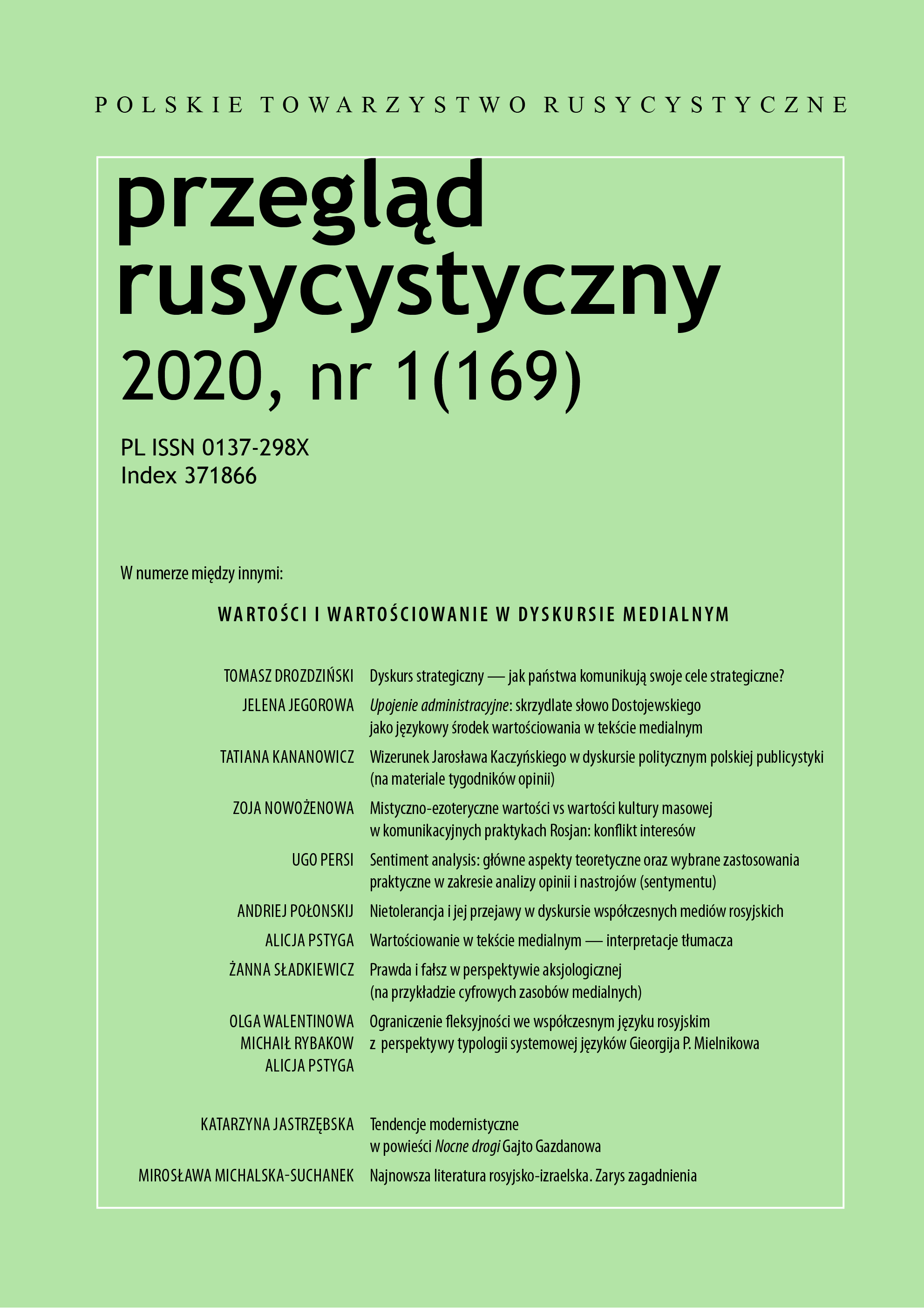
Wartości i wartościowanie w dyskursie medialnym wyznaczyliśmy jako główny temat, wokół którego koncentrowały się wystąpienia oraz dyskusje rusycystów z Gdańska, Bergamo, Biełgorodu i Moskwy podczas ostatniego seminarium zorganizowanego w ramach działalności afiliowanej przy Wydziale Filologicznym Uniwersytetu Gdańskiego Pracowni Badań nad Komunikowaniem Medialnym (12 kwietnia 2019 r.). Wystąpienia te stały się podstawą publikacji prezentowanych w bloku tematycznym pod tym samym tytułem: Wartości i wartościowanie w dyskursie medialnym. Składa się nań 9 artykułów, z których każdy przedstawia osobliwości wybranego fragmentu współczesnej medialnej przestrzeni dyskursywnej i właściwego mu problemu szczegółowego – przede wszystkim Rosjan, aczkolwiek niektóre z mają wymiar bardziej ogólny, odnosząc się do zagadnień aktualnych dla każdej społeczności językowej.
INTRODUCTION TO RESEARCH ON STRATEGIC DISCUSSION INITIAL. CONSIDERATIONS AND BASIC TERMINOLOGY
The article presents general considerations regarding strategic discourse. The use of the discourse model to describe the strategic communications’ mechanism between national security actors, especially states, has been proposed. The subject matter of the article is interdisciplinary.
The given paper is dedicated to the analysis of the word combination “administrative delight”, which was firstly used by F. Dostoevsky in his novel Demons to describe the bureaucratic arbitrariness, and later on became a figure of speech. By considering the examples of the usage of the mentioned stylistic device in Russian, Ukrainian and Polish mass media, the context extension and the change of semantics were pointed out by the author of the paper. The undertaken research leads to the conclusion about the universality and the convincing factor of the viability of the figure of speech created by F. Dostoevsky.
Image of Jarosław Kaczyński in Political Discours of Polish Journalism (on the material of opinion-based weeklies)
In the article the author introduces the semantic structure of the positive and negative images of one of the most popular Polish politicians of last decades – Jarosław Kaczyński, on the basis of political narration of two competitive weeklies – „Newsweek Polska” and „Sieci”. Under this approach the image is defined as a complex semantic construction consisting of at least few semantic representations concentrated around labels (basic nominatios). Both weeklies present different images of the politician, using various linguistic and textual means.
Mystic and Esoteric Values vs Values of the Mass Culture in Communicative Practices of Russians: the Conflict of Objectives
In the article the author analyzes the process of creation in the communicative space of Russia of the esoteric discourse presenting and spreading esoteric values. On the periphery of this discourse, in the media space, we can observe the “invasion” of the mass culture into the field of esoteric values. On the level of discursive practices it occurs in deformation of the canon of esoteric genres — horoscope and mass culture genre — advertising. The process manifests in purposeful choice of language means helping to create the order of the discourse.
Sentiment analysis: the main theoretical prerequisites and some empirical application
The article discusses the main theoretical prerequisites for the development of methods of Sentiment Analysis and the practice of expanding their empirical application to such areas of communication as marketing, services, social media and blogs. This linguistic computational approach to texts is based on the consideration of human emotions. Scientific implementation of Sentiment analysis in some countries is analyzed.
В статье рассматривается интолерантность как широко востребованная сегодня культурная и коммуникативная норма, как ключевой нравственный, мировоззренческий и коммуникативный принцип, который определяет доминирующий в обществе тип циркулирующих смыслов, высказываний и текстов. Автор рассматривает ее отдельные виды в современных российских СМИ.
Valuation in media discourse — translator’s interpretations
The paper touches the matter of evaluation in press discourse which is presented from the perspective of Russian press articles translation into Polish language. Axiology in terms of press articles translation – creative, also usually persuasive, in which various means are used as carriers of evaluative connotations describing the matter of statement in negative or positive way – prompts us to consider to what extent the original evaluation is reproduced (or changed). The author proves that the holistic view on original and translated media texts allows to discover also other important elements of press articles structure which presence, emphasis or omission influences axiological valuation.
Artykuł poświęcony jest analizie stosunku aksjologicznych kategorii prawdy i fałszu (fake, mistyfikacji) w cyfrowej przestrzeni informacyjnej. Ewolucja mediów internetowych zakwestionowała podstawowe zasady dziennikarstwa, przede wszystkim jego orientację na obiektywność i wiarygodność w przekazywaniu treści. Prowokacyjność i symulacyjność nie tylko zyskały status ekspresji epoki postmodernizmu, ale stały się również uniwersalnym algorytmem zachowań społecznych. Artykuł dotyczy takich wektorów funkcjonowania fałszywych informacji, jak clickbait, wiralna reklama, fejkowe aplikacje i programy, witryny do generowania fałszywych informacji, cyfrowe algorytmy służące do audiowizualnego fałszowania treści. Badanie wykazało, że intersemiotyczna architektura przestrzeni cyfrowej umożliwia aktualizację nieprawdziwych toposów wydarzeń i kreowanie sfałszowanych informacji, przekształcając Internet w narzędzie programowania ideologicznego.
The authors of the article discuss from the standpoint of the G.P. Melnikov's systemic typology of languages the phenomena characteristic for speech works of all functional styles of the modern Russian literary language that indicates violation of flectionality of the Russian language. The external preservation of inflexion and grammatical coordination in the event of violation of the forecast function in the designation of cause-effect relationships of the developing events, does not indicate flexiveness.
The article analyzes distinguishing characteristics of the novel Night Road by Gaito Gazdanov. The main theme of the article is a typical for this novel personal narrative, i.e. where the narrator is a hero and a participant of the events at the same time. The analysis of narrative techniques of this novel is a starting point to determine the semantics of the novel, and simultaniously, it is a base for the thesis that the novel proves modern tendencies and has nonhomogenous genre.
THE LATEST RUSSIAN-ISRAELI LITERATURE. OUTLINE OF THE ISSUE
The latest Russian-Israeli literature is losing the features of marginal and peripheral literature (although in both Russian and Israeli cultural spaces it is still — despite the changes — perceived as such). This is mainly due to the multifaceted process of demarginalization that has been dynamically developing in the last two decades (Roman Katsman's concept). It slowly gains the status of autonomous literature, which operates within a separate, own cultural world, outside the structure determined by centers and peripheries.
recenzja książki Ludmiła Mnich, Шекспир в русской теории первой половины ХХ века, Wydawnictwo Naukowe Instytutu Kultury Regionalnej i Badań Literackich im. Franciszka Karpińskiego, Siedlce 2019.
