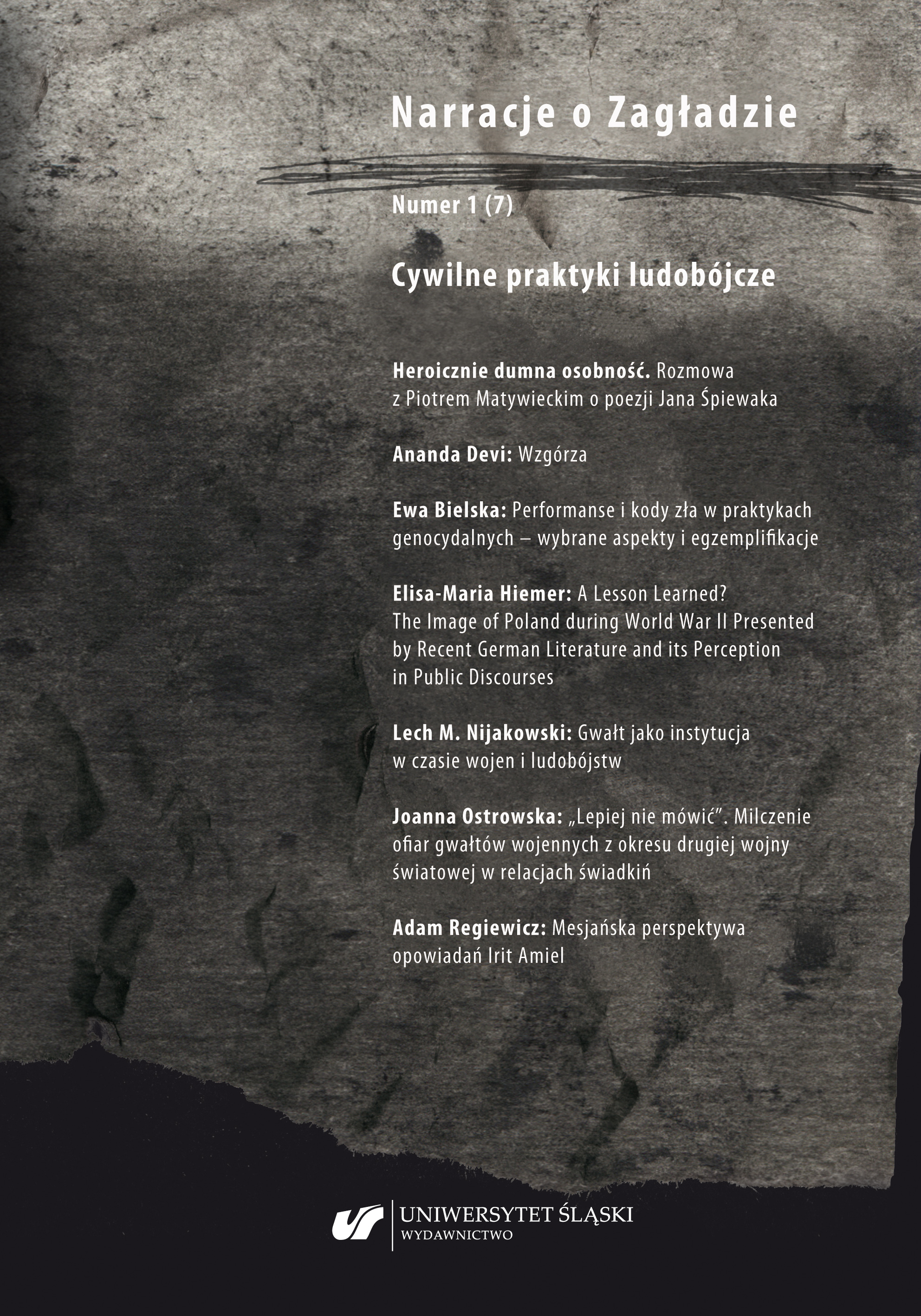
This article discusses five non-formal institutions of rape from the perspectives of historical sociology and genocide studies, distinguishing types of rape on the basis of a comparative historical analysis of ten cases: (1) rape as reward for soldiers and other combatants; (2) rape as a method of initiating soldiers, integrating the military group, and legitimating masculinity; (3) rape as an offensive institution, fulfilling two functions: (3.1) symbolic attack on an enemy group; (3.2) increasing damage/cost to the enemy by making their lives harder in terms of trauma to women, the raising of unwanted children, and so on; (4) rape as a method of ethnic cleansing; (5) rape as a form of genocide. The five types of rape are regarded as institutions: expressions of culturally fixed values and norms which determine accepted goals and the methods of attaining those goals and are embedded in the subcultures of particular organizations (the army, the police, party militia groups, etc.). Not every rape is related to these institutions. In this sense, rapes can be regarded by members of a particular organization as justified or unjustified. Moreover, perpetrators may feel institutionally compelled to engage in the raping of victims.
“Better left untold”, “There was no opportunity”, “I wanted to talk about it, but there was no one to talk to” – these are the most frequently occurring statements by female witnesses and victims of sexual violence during World War II. They also repeatedly crop up in accounts of rape victims during other military conflicts in the XX century. In the narratives, the most frequent statements are those which attempt to repress the experiences and which communicate a fear of stigmatization. Not only was there no one who would listen; the very act of talking about “it” entailed consequences. All of the female witnesses and victims whose testimonies are analyzed in this article have drawn attention to the fear of stigmatization, especially after the War, among relatives, neighbors and other people. The witnesses’ micro-narratives are a point of departure for an analysis of rape in the last months of the War in view of the lack of victims’ accounts. Why didn’t the women speak out? How did they cope with the trauma of sexual violence? What eventually made them decide to speak?
The topic of this article is the use of selected patterns of the imagery of evil within studies of war atrocities and acts of genocide. The characterization of “evil” in this paper is informed by the anthropological perspective, with the imagery of evil juxtaposed against anthropologically (i.e., cultural, human, and reflective) practices of humiliation, violation of taboos, and the location of victims in matrices of impurity and exclusion. In his analysis, the author Martin Pollack considers the contaminated landscape through the lens of the practices of taboo violation, including the prevention of burial and the performance of genocidal rape.
This article presents a broad commentary on the translation of parts of the book The Ethics of the Siege of Leningrad: The Concept of Morality in Leningrad in 1941–1942 [Блокадная этика: представление о морали в Ленинграде в 1941–1942 гг.] by Sergey Yarov. The author shows how representations of the siege have changed in post-war Russia, especially since the collapse of the Soviet Union. Against this background, the author discusses Polish publications on this subject.
The landscape of conflict is a conception which has recently attracted a lot of attention in landscape studies. It chiefly inspires studies that represent the field of the archeology of the present, thus constituting one of the keys to reading? history from the structures of the surrounding cultural landscape. This article proposes to extend the conception of the landscape of conflict into the discourse about Jewish material religious heritage. Attention paid by the humanist to materiality reveals new contexts of the Holocaust, including its non-human, landscape representations. Here, an adaptation of the conception in the studies of Jewish religious heritage has been carried out on the example of research conducted in the vicinity of the New Jewish Cemetery in Łódź. This article presents the results of studies of chosen elements of this landscape of conflict, elements which, along with other functions, constitute the physical fact of the gravestones of the necropolis. The research drawn upon was gathered using the methods of non-invasive field documentation; the analysis involves the comparisons of photogrammetric and teledetection data, including point clouds obtained by laser scanning and aerial photographs. These were the basis for the spatial models of the structures of material heritage under consideration, which constitute historical palimpsests, and for the identification of the elements of this landscape of conflict.
This article delivers an analysis of the functions performed by native Poles in the intergenerational transmission of the trauma of the Holocaust in Polish-Jewish families. For its source material, the author has chosen Ewa Kuryluk’s post-memory literature, textual testimonies by representatives of the second generation of mixed-background families: parents, one of whom survived the Holocaust, and the other, who, after the War, became a custodian of the secret and helped to put the traumatic experiences into written form. In the description of the complex processing of the trauma of the Holocaust, the psychoanalytic understanding of intergenerational transmission proves to be helpful. Similarly helpful is the idea of the “third”: a compassionate witness and mediator/transmitter of experience who makes deliverance possible. A close reading of Kuryluk’s post-memory trilogy allows for an inspection of a heretofore unexamined aspect of the intergenerational transmission of trauma.
Irit Amiel is an Israeli writer who, after almost fifty years of silence since being saved from the Holocaust, speaks on the Shoah. Her stories are a collection of portraits. In these stories, the author uses restrained and understated narrative modes in order to depict the fates of Holocaust survivors. Until recently, readings of texts dedicated to the Holocaust have marginalized the presence of the Biblical tradition, ignoring its contribution to the sense of identity among Jewish individuals. This article is an attempt to read Amiel’s short stories from a messianic perspective arising from the spirit of post-secularism. This perspective is helpful in a reading of the archetypal narrative of Israel’s Exodus, which constitutes the foundation of Jewish identity. As Amiel herself has shown, we cannot avoid mention of Biblical narratives when speaking of the Shoah experience.
This article aims at identifying and reviewing themes within Polish 21st-century children’s literature related to the Holocaust in order to enumerate the dominant trends in the presentation of the Shoah. The first part of the article outlines the emergence of the works of children’s literature under consideration, while the second part analyzes the following topics, not only in terms of the inclusion in these works, but also, in certain cases, their omission: Jewish culture and religion, Polish-Jewish relations, and the circumstances surrounding characters’ deaths. The analysis culminates in a series of conclusions regarding, and a discussion concerning, the ideological background of literature for young readers during the 21st century.
Based on Wolf Schmid’s Narratology, this article depicts the influence of the so-called abstract dimension on the reception of Kevin Vennemann’s Nahe Jedenew (Close to Jedenew, 2005) and Matthias Nawrat’s Die vielen Tode unseres Opas Jurek (Numerous Deaths of Grandpa Jurek, 2015). The abstract dimension – being, among others, the result of personal beliefs and individual “literary experiences” – helps to understand contradictory opinions about the same work and depends often (but not exclusively) on different historical knowledge and awareness. The reception in the media and academic discourse reveals schemata that cannot be explained by the text alone. I argue that the recipient is highly influenced by the author’s personal background, although it is not about autobiographies – which clearly reduces options for interpretation.
This article examines the form and content of the artistic radio programs created by the Lublin-based journalist Maria Brzezińska, in particular reportage and radio plays [słuchowiska]. These programs introduce the topic of the Holocaust into the domain of audio culture texts. The journalist’s methods of constructing narrative and composing audio pieces represent different ways to talk about the Holocaust, in particular through documentary forms and fictional genres. The analysis of the programs at hand has allowed the author to enumerate the singular stylistic features of the artist, among them the dominating distinct perspective of the narration as it builds, the condensing of content, and the awareness of the author’s presence during the recording.
The author of this article considers the emotions expressed by the Mauritian writer Ananda Devi in the literary aftermath of her May 2019 visit to the Auschwitz-Birkenau Museum, a memorial to mass extermination. Devi’s novella Hills, deliberately conceived as a nekyia, recalls to life, and in fact re-embodies, victims of Auschwitz. The novella can also be thought of as a sort of virulent fragment, stuck to an unpublished novel about a subject completely unrelated to Poland and concerning a phenomenon that the writer perceives as necro-tourism. Looking at the Holocaust from the point of view of her homeland, for which South Africa is the best known point of reference, Ananda Devi expands her vision of violence to consider the phenomenon of apartheid, mass communist crimes in the People’s Republic of China and the bloody Arab-Israeli conflict in the territory which now belongs to Israel. Devi’s reflections represent a broader current in her thinking, the most recent expression of which is the tri-lingual poem Ceux du large, which treats of the tragic fate of immigrants on their way to southern Europe by sea.
The text discusses an interview conducted by Wiktor Krajewski with Alina Dąbrowska, one of the last living witnesses of history, a prisoner of five concentration camps, forced to participate in two Death Marches. While discussing her most difficult experiences during the Second World War, Dąbrowska attempts to assess the human relations. By divulging and explaining what influenced her life choices, how she perceives the infernal life of concentration camp and how she sees herself, she reveals her ethical investment in narrating her own life story.
The reviewer has referred to the goal of the book, which (according to its author) has been to describe and codify the labor-camp/prison letter in its theoretical and practical aspects. Significant features of the research include a description of the interaction between the letter writer and the addressee, as well as an analysis of the functions both of the epistolary dialogue and of the interpersonal relations involved. The source material for Lucyna Sadzikowska’s analysis consists of unique collections of laborcamp and prison letters from the period 1939–1945. They were written in different concentration camps in Poland and across Europe. Their analysis is an integral part of discovering and describing (from different research perspectives and with the help of various methodologies) the war drama, as it arose from the experience of totalitarianism. Due to their individual character, letters written in constitution camps constitute an exceptional testimony of the fate of all the victims who suffered humiliation in these places. In a sense, the letters of prisoners are an echo of the inner struggle for justice, and can be seen as attempts to preserve human dignity. Interestingly, the author of the book has invented an inspiring method of reading this type of epistolary literature, contextualizing the analysis in terms of the individual fate of the senders and the addressees. In the opinion of the book’s reviewer, the source documents (published in the form of annexes) are truly invaluable. They include Franciszek Ogon’s camp letters (Annex I) and the reminiscences of Alojzy Fros about Franciszek Ogon (Annex II). The reviewer rates high both the content and the scholarly features of the monograph and emphasizes that, on the basis of intriguing epistolary material, Lucyna Sadzikowska has created a successful and interesting synthesis, which takes into account various interpretive perspectives. In this way, the book may be seen as an effort to contribute to the emendation of the shortage of such publications in Polish literary studies.
This article is a review of Anita Jarzyna’s book Post-koiné. Studia o nieantropocentrycznych językach (poetyckich) [Post-koiné. Studies in Non-anthropocentric (Poetic) Languages]. The reviewer discusses the literary material upon which the book’s analysis focuses; the interdisciplinary theoretical basis used by the scholar; the theme of memory, particular the possibilities of writing a “shared” universal history without excluding animals; and, last but not least, the theme of the emotional nature of animals, the possibility of representing it in literature, and the question of the place which animals inhabit in language.
The article is devoted to the first novel of the Sorbian writer Jurij Koch entitled Židowka Hana [The Jewess Hana], published in 1963. Curiously, it contains in its title the ethnonym “Jewess,” which breached the antisemitic line then adopted across the Soviet bloc. Perhaps, this ideological transgression explains why this novel was not translated into German or the bloc’s other languages during the communist period. Sorbian-language novels were (and still are) few and apart, so the East German authorities, for the sake of the official promotion of minority cultures, supported the translation of them into German and other “socialist languages.” But not in this case. The important work languished half-forgotten in its Upper Sorbian original and in the 1966 Lower Sorbian translation. Only three decades after the fall of communism and the reunification of Germany, the author prepared and successfully published the German-language version of this novel in 2020.



 Język Polski
 English
 https://doi.org/10.31261/NoZ.2021.07.02