

ER(R)GO is an international, bilingual, learned journal dedicated to problems of literary and cultural theory. Inspired by the intellectual achievement of the interdisciplinary seminar group functioning at the University of Silesia in Katowice under the same name, it fosters theoretical reflection upon essential problems of culture and the human within it. Er(r)go is a periodical focusing primarily upon the reflection upon the products of contemporary culture, including popular culture, with particular emphasis on critical theory and related problems. The areas of central importance to the journal include the analysis of phenomena impacting the shape and functioning of culture, the study of literary works, film, works of fine art and other products of culture, the insights into literary and cultural processes and factors conditioning their development, analyses of context determining such processes, as well as reflection upon the methodology of literary and cultural studies, analyses of tendencies manifest in the culture of today and their intellectual foundations, transformations of theoretical and methodological paradigms, studies in ethical and axiological frames within which literary and cultural currents and phenomena related thereto are located, literary-theoretical and culture studies oriented syntheses, as well as studies focusing upon the mutual relations between literature and philosophy as well as other disciplines within humanities and beyond. While Er(r)go puts particular emphasis on literary theoretical investigations, the important focus of the journal is upon the perceptions of the literary texts in relation to con/texts and pancultural processes. The mission of the journal is to bridge the areas traditionally covered by literary-critical and literary-theoretical periodicals and those profiled towards culture studies, and thereby to open a wide space of dialog in which these two broad disciplines can meet. The overall tenor of the journal should be described as interdisciplinary.
The Journal is financed from the Statute Research Fund of the Institute of Literary Studies, Faculty of Humanities, University of Silesia in Katowice, Poland. The journal does not charge any fees for publishing articles and is available free of charge in the Open Access Gold formula (READ MORE...)
Issues in production
Submissions now closed – 51 (2/2025) - ruins/remnants/remains (click to read more)
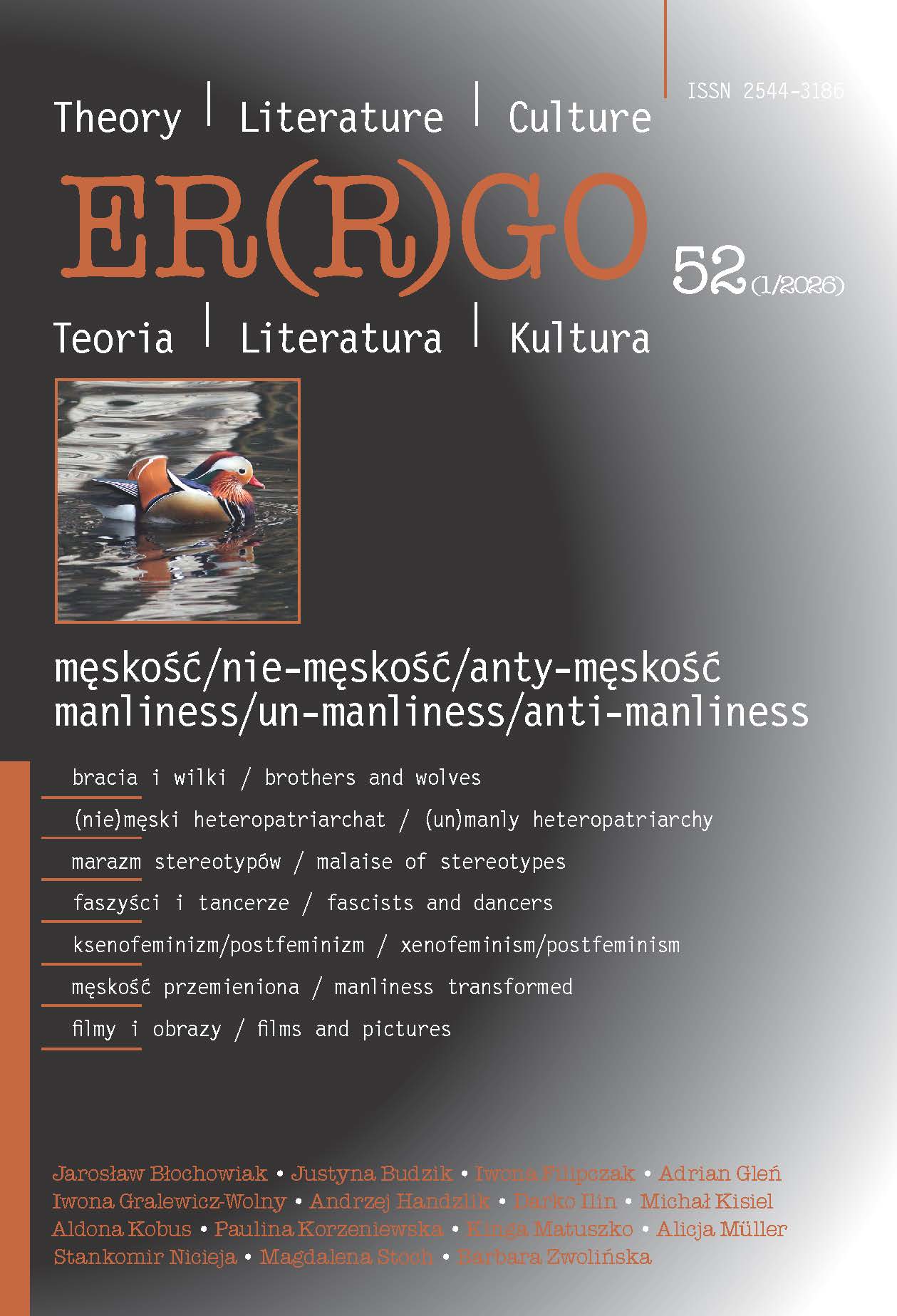
Submissions now closed – 52 (1/2026) – manliness/un-manliness/anti-manliness (click to read more)
Submissions now closed - 53 (2/2026) - tissues/things/matters (click to read more)
Active Calls for Papers
Next issue - 54 (1/2027) - home/homeliness/homelessness (click to read more)
Next Issue – 55 (2/2027) – game/play/idleness (click to read more)
From Data to Scenarios: On the “Imaginative Coefficient” of Futurology 1663
1663
Artificial Intelligence and the Limits of the Humanities
700
The Eco-Logic of Olga Tokarczuk’s Prose Worlds Tenderness and Anger as the Pillars of a New Order
538
Exodus or Exile: The Trope of "more life" in Louise Glück’s Poetry
457
2026-01-19
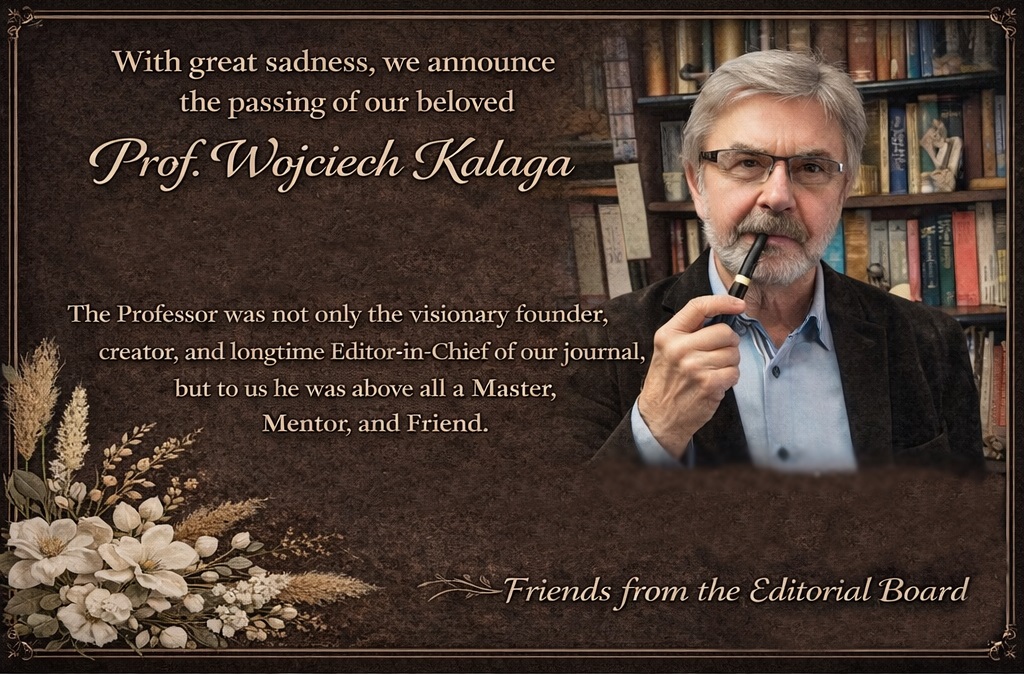
Pogrążeni w żalu, zawiadamiamy, że w wieku 76 lat zmarł
Prof. zw. em. dr hab. Wojciech Kalaga
Profesor był nie tylko pomysłodawcą, twórcą i wieloletnim Redaktorem Naczelnym naszego pisma, ale dla nas był przede wszystkim Mistrzem, Mentorem i Przyjacielem.
Wdzięczni za to, co wniósł do życia każdego i każdej z nas, za niezliczone rozmowy, spotkania, burze mózgów, a także za ogromne dziedzictwo tekstów, które po sobie pozostawił, łączymy się w bólu z Najbliższymi Naszego Profesora.
Przyjaciele z Redakcji
2025-12-01
Next Issue – 55 (2/2027) – game/play/idleness
submission deadline: 15 September 2026
Thinking about game, play, and idleness seems as light a task as it is suspicious. Contemporary Western humanities—shaped by the ethics of productivity, useful knowledge, and constant activity—have long looked with unease at whatever serves no purpose, slips through the logic of efficiency, or may be dismissed as a waste of time. Yet it is precisely in what appears unnecessary that an anthropological key to modernity may be found: the playing human, the playful human, the resting human might well embody what defines the lifestyle of the early twenty-first century. From Friedrich Schiller’s philosophy of play, through Johan Huizinga’s Homo Ludens and Hans-Georg Gadamer’s hermeneutics of play, to contemporary diagnoses of late-capitalist culture, play and idleness appear less as the margins of social acceptability than as attempts to preserve meaning. (Click here to read the full CFP)
2025-09-24
Next issue - 54 (1/2027) - home/homeliness/homelessness
Submission deadline: February 28th, 2026
In the Western humanities, home as a project is both unfinished and overdone. Indeed, human physical and intellectual connection with the world relies on transgressing boundaries and setting them anew, and defining one’s right to inhabit a given place and to use what it has to offer. In the third decade of the 21st century, such an idea seems to be hardly tenable, while home happens to be a concept which resists stable or exhaustive definitions. (Click here to read more)
2025-01-07
Next issue - 53 (2/2026) - tissues/things/matters
Submission deadline: 15 Sept. 2025
Although the Western humanities have attempted to organise the world critically and creatively by referring to stable categories of subjects and objects, they still largely fail to grasp tangible reality. The intellectual framework supposed to pinpoint it often backlashes in a utopian view, which, instead of making it possible for us to cognise the material, locates it in irreducible distance, impossibility, or aporia. Continental literary and cultural theories of the so-called “Linguistic Turn” are arguably the last descendants of this tendency, as they effectively reduce the humanities to textual determinism. After all, thinking rooted in two-fold signs has never intended to bind a concept with its material counterpart. It rather privileges an auditory or visual residue of reality: a signal supposed to evoke the concept. (Click here to read the full CFP)
2024-10-03
Next issue – 52 (1/2026) - manliness/un-manliness/anti-manliness
Submission deadline: 30 January, 2025
The critique of patriarchy, prevalent in contemporary humanistic discourses, has relegated the notion of masculinity to the status of a historical anachronism identified with most of the dramas of the contemporary world, from corporate-military imperialism to objectification of women to environmental devastation. Fuelled by constantly reproduced media stereotypes, masculinity/manliness has become synonymous with innate aggression, programmatic dominance, perpetual competition, ubiquitous rationalism, and the relentless need for optimisation and efficiency legitimised by the measurable successes of the Western model of socio-technological existence. And when views that challenge masculine identity built on these stereotypes come to the fore, the identity in question is almost immediately perceived in terms of a new collocation - a crisis of masculinity and of manliness. (Click here to read the whole CFP).
2023-10-14
Submissions now closed - 50 (1/2025) - reflection/distance/irony (Click here to read the full CFP)
No. 52 (2026)
Published: 2026-07-03
 10.31261/errgo

MNISW: (2024) 100
Original size after clicking











 English
 Język Polski