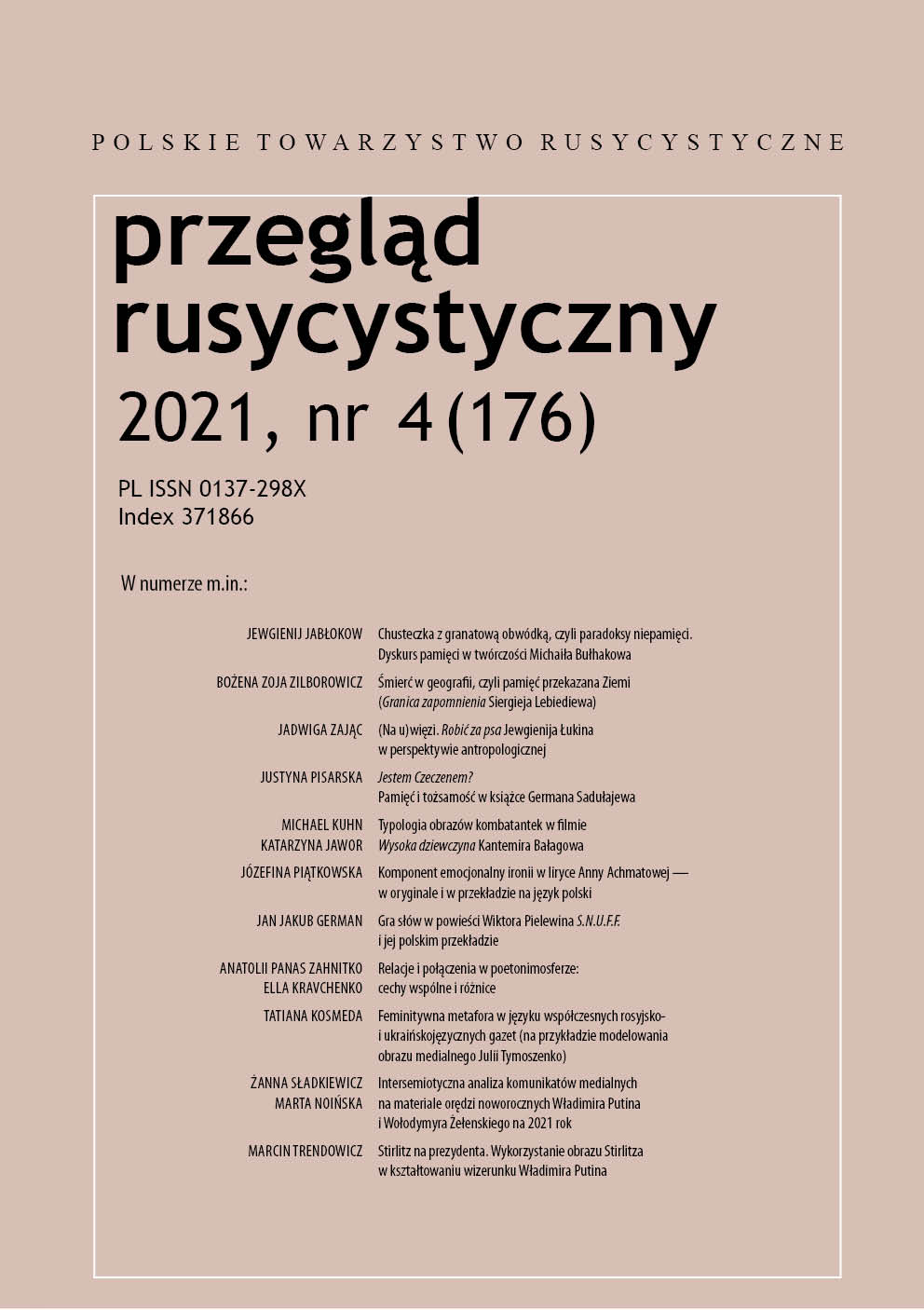
The category of memory is one of the philosophical dominants of Bulgakov's world. Memory is able to "neutralize" time, resurrecting the past. However, the content of Bulgakov's heroes memories consist of frustrating or even disastrous events. Therefore, the desired option for them is a complete repression, an "erasure" of such information. In philosophical sense, the thirst for oblivion means the desire of Bulgakov's character to break away from time as an ontological coordinate and go into eternity, to find peace both in the psychological and ontological sense. At the plot level memorial collisions are often realized through the motive of a mental disorder and / or associated with it suicide, which symbolizing the stage of calm, "nirvana" of oblivion. In formal, а calm can be associated with entropy, the death, but essentially it means condition "between" being and non-being, a euphoric state of deliverance from earthly troubles and sorrows.
The objective of this article is to analyse the topography of the novel “Oblivion”, understood as the comprehensive system of nature’s components by which the writer rises the question about the lost and forgotten post-existence of the Soviet Gulags. In Lebedev’s work, the nature appears as a destructive element, transforming the Gulag’s Atlantis into the world of abstract deaths, performed in a physical dimension, however, devoted of a socio-cultural dimension. The natural landscape does not act as a bearer of a historical memory; conversely, it is a silent witness whose silence calls into question the very existence of the concentration camp as a crime scene
The anthropological approach to issues commonly discussed from a political and economic point of view offers an interesting insight into the latest Russian fantasy literature. This text introduces optics taken from the already classic in some circles works of David Graeber into the field of reflection on Russian contemporary prose. Beginning with Graeber's concept of bullshit job, outlines an anthropological interpretation of the actions of Yevgeny Lukin's hero of the novel Чушь собачья . Its point od focus is the problem of emotional exploitation at work, leading to psychological destruction, to the point where the outside of work self of the worker is reduced to an uncomfortable remnant, sacrifice of which no longer seems to be any serious loss and the highest sacrifice becomes welcomed as a kind of a relief.
The article is devoted to the themes of memory, identity, and the ways they are presented in I am a Chechen! by German Sadulajev. Different memory theories (Maurice Halbwachs, Jan Assmann, Birgit Neumann) employed in this study prove that memory affects identity. Following this lead, we come to conclusion that memories in I am a Chechen! help the author to re-create his devastated by the collapse of Soviet Union and two wars identity. But memory affects not only the identity, but also the form of this book, which makes an impression of being incoherent and disjointed, but still completed. Thus, the attempt to show that this book shares some characteristics with more acknowledged genres has been made.
In this article with the use of descriptive-functional and comparative research methods are analyzed and compared with each other the two main characters of the movie Beanpole (2019) by Russian director Kantemir Balagov – young female front-line soldiers Iya and Masha, who are trying to start a peaceful life in post-blockade Leningrad.
Detection and translation of irony is one of the most complex tasks for translators. This especially relates to the translators of literature, where irony becomes “the domain of diversity” and might escape the attention even of a professional literary critic, as Michał Głowiński puts it. The aim of this article is to trace the emotional component of ironic utterance. A comprehensive linguistic analysis of chosen texts will be undertaken in order to show how emotions can be expressed in a poetic text and how they are involved in the formation of irony. The examples will be provided from Anna Akhmatova’s poems and their translations into the Polish language. The comparative perspective enables to estimate how various transformations of the emotional component can impact the expressiveness of irony in a translation.
The article aims todescribe the examples of wordplay in the novel "S.N.U.F.F." of V. Pelevin and analyze the translation of these examples in the Polish version of the novel. In the introductory part some theoretical problems concerning wordplay are presented. The main part contains the most interesting examples of wordplay from the novel, the explanation of how the comical effect is obtained and the analysis of the translator’s decisions. In the final part the conclusions are presented.
This article concentrates on the connections and relationships (poetonym ↔ poetonymosphere) → texts, which determine the co-development of the onym – integrity (text) essence.
It is proposed in the paper that the concept of the poetonymosphere is a hierarchical system of elements (onyms) of a complete text, integrated into heterogeneous complexes (a microsystem, a macrosystem, a supersystem). It has been proved that the result of the sound-semantic connection of poetonyms is the relationship of equivalence, inclusion, intersection, contrast and contradiction, ensuring the unity and integrity of the literary text. The identical / similar form and the corresponding semes (identical, integral, differential, antonymic, mutually exclusive semes), which constitute the content, contribute to the creation of certain relationships in the poetonymosphere.
The newspaper discourse captures the active language processes, consistently reflects the sequence of events which take place in the society, provides the possibilities for modeling the media image of the political leaders, in particular, the woman politician Yuliya Tymoshenko, while demonstrating the ample opportunities in order to create the metaphors, the periphrases, the language games based on the precedence actualization and the anthroponym systems taking into consideration the gender principles – the androcentrism, the sexism and the femininity.
In recent years researchers in humanities and social sciences have been searching for an approach allowing for an exhaustive and accurate description of contemporary communication. The authors point to the trend towards visualization in the media and to the increasing interconnection of various semiotic systems observed in contemporary media texts. Some methodological solutions are presented on the example of the intersemiotic analysis of the New Year’s addresses by Vladimir Putin and Volodymyr Zelensky for 2021.
The article discusses the relationships between Stierlitz, a hero of Russian mass culture, and Vladimir Putin, as well as the ways these relationships are used to shape the image of the President of the Russian Federation. The research is based on the findings of opinion polls, newspaper headlines, jokes and memes from the Internet.
The review presents the study of mass consciousness in Russian Empire before and during World War I and the 1917 Revolution. Vyacheslav B. Aksyonov analyses the role and functions of rumours in various groups of Russian society at this period. He describes the situation of dramatic misunderstanding, signifying the conflict between traditional culture and culture of modern. The mass sentiment of Russians are reconstructed on a numerous sources by methods of historical anthropology.


 10.31261/pr


 Język Polski
 Русский
 English