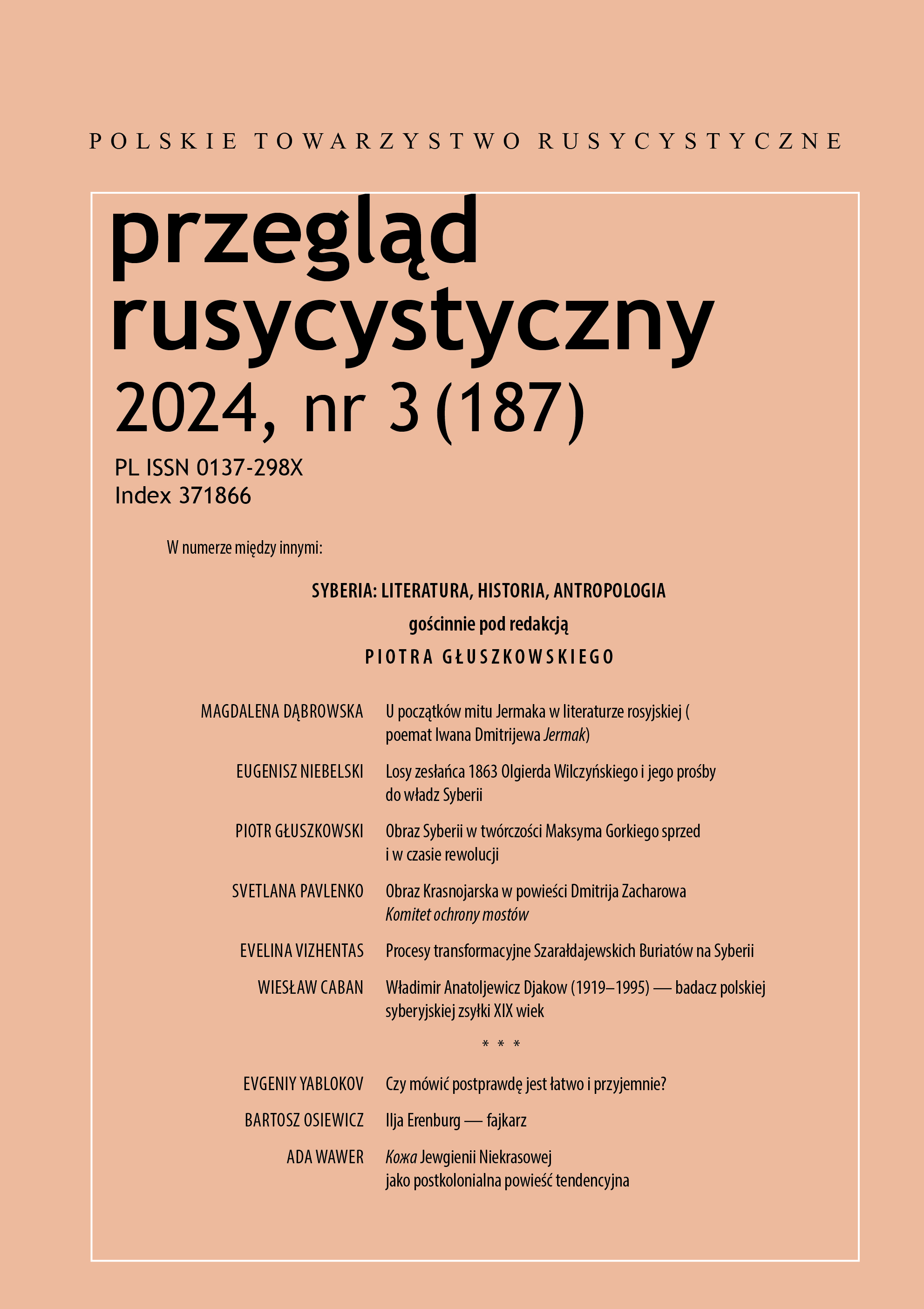
Since the 17th century, Poles were regularly sent to Siberia, but it is only the second half of the 18th century when one can refer to mass deportations. Polish exiles were amongst the first researchers of Siberia. The tradition of Polish research into the geography, history, nature, literature and everyday life of Siberia has continued for more than two hundred years. This article addresses the history, current state and prospects of Polish studies of Siberia.
The paper presents the dramatic poem Yermak (1794) by Ivan Dmitriev from a perspective of the conception of myth. Yermak Timofeyevich (1532?-1585) was a Cossacs ataman and is today a hero in Russian folklore and myths. A methodological basis are the definitions of myth by Ryszard Tomicki (an ethnologist) and Jerzy Topolski (a historian), historical myth and political myth. An interpretive background is the literary programme of sentimentalism, the Ossianism and the historiographic works by Nikolay Karamzin (the picture of Siberia in the 9th volume of the History of the Russian State). The origin of Dmitriev’s poem were by the literary (poetics of sentimentalism, the Ossianism) and ideological factors (acceptance of territorial development of Russia, sacralisation of the figures).
Keywords: Yermak Timofeyevich, myth, Siberia, Ivan Dmitriev, Yermak, Ossianism
The text characterizes the fate and achievements of the participant of the 1863 uprising sent to exile to Siberia, Olgierd Wilczyński from Lithuania, who, after returning from exile, tried to pursue a scientific career and join the scientific circles of Polish historians. In St. Petersburg and Vilnius, at the turn of the 19th and 20th centuries, he published brochures and texts, among others: on history and archeology - about the antiquities of Rus', Russia and Europe. In connection with his work in the field of genealogy, in 1911 he was also imprisoned in Vilnius and was tried for falsifying archival documents. In 1916 he was in St. Petersburg, but his further fate is unknown. His works, especially on the beginnings of Rus', are nowadays re-published in Russia, although his biography is not known.
The article deals with Maxim Gorky's connections with Siberia and its inhabitants until the end of the Russian Civil War (1917-22). From the beginning of his literary career, Gorky often referred to Siberia, its importance and role in the Russian Empire. He was convinced that the activity of the Siberians could stimulate the inhabitants of other Russian regions to act and fight against autocracy. Although he never went beyond the Urals himself, there can be no doubt that Siberia always attracted his attention. The article was based both on Gorky's correspondence with Siberians and on his prose.
The article aims to analyze the portrayal of a Siberian city, illustrated through Krasnoyarsk in Dmitry Zakharov’s novel The Committee for the Protection of Bridges (2022). The theoretical and methodological background of the study consists of the works of scholars affiliated with the Tartu-Moscow semiotic school and other experts specializing in the study of Siberian texts within the Russian literary context. Zakharov’s Krasnoyarsk is a complex multifaceted spatial construct encompassing socio-political, cultural-historical, economic-ecological, and mythological dimensions. The author creates a negative image of the city, mainly criticizing the policies of the local authorities. The article considers the fundamental elements of the urban landscape, the most important objects and space motifs, as well as some types of characters and their ways of experiencing Krasnoyarsk.
The culture of the Buryats, like many other peoples of the world, is undergoing complex processes of transformation of its traditions, rituals, and language. This was certainly influenced by the geopolitical nature in society, as well as socio-cultural changes. The article is devoted to the problems of transformation of the culture of the Sharadevski Buryats living in the Irkutsk region in Siberia. The appearance of the Sharadaev family, their interaction with Russian culture is presented, and it is also shown how the Buryats interacted with the Poles living in their neighborhood.
Vladimir Anatolyevich Dyakov's publications on the history of Polish Siberian exile are of still actual. He was one of those Russian historians who were the experts in the sources on Polish affairs stored in the central and Siberian archives. He contributed mostly to expanding our knowledge about deportation by using the rich documentation stored in the State Military Historical Archives in Moscow (RGVIA), to which Polish researchers had practically no access until the political changes in the USSR. Vladimir Dyakov addressed various issues related to the Polish exile in the 19th century, but he was most interested in the scale of the contribution of Poles to the civilizational development of Siberia. He also tried to set research directions. Some of his proposals, to a greater or lesser extent, have been taken up by Polish historians. The other ones are waiting for a change in the political situation.
The aim of the article is to look at the figure of Ilya Ehrenburg (1891–1967) and collection of his short stories Thirteen pipes (1922) through the prism of auto/biographical writing. This perspective will allow to reconstruct the creative process of Ehrenburg the pipe maker, which emerges both from the texts of his contemporaries’, as well as from the writer's correspondence with friends and acquaintances. A careful reading of the correspondence exchanged by the writer and a comprehensive reading of the reviewers' opinions will also allow to reconstruct the circumstances of the work's creation, describe its publishing fate and readers’ reactions. What is more, the very contact with the text of the literary cycle will contribute to the separation and presentation of a diverse collection of pipes that Ehrenburg made with the help of artistic expression.
This article examines the novel Кожа by Yevgeniya Nekrasova as a work that is, on the one hand, contemporary in content and, on the other hand, outdated when viewed from the point of view of form. In the beginning, the author draws attention to the influence of contemporary cultural theories. The analysis uses concepts such as postcolonialism, intersectional feminism, Marxist cultural theories, decoloniality and internal colonization. The focus of the research then shifts to the issues of form. Problems such as tendentious and didactic nature of literature are discussed. The author confronts the text with such types of tendentious literature as positivism and social realism.
The text contains a testimony of Stanisław Majdański, which is both the memories of the little exile, as well as the story and reflections of an adult man.Born in 1935, as a 5-year-old child, he came to the Siberian exile in 1940 after the arrest by the NKVD.Memories have been developed by prof.Eugeniusz Niebelski, with minimal editorial interference in order to maintain documentary and historical value


 10.31261/pr


 Język Polski
 Русский
 English