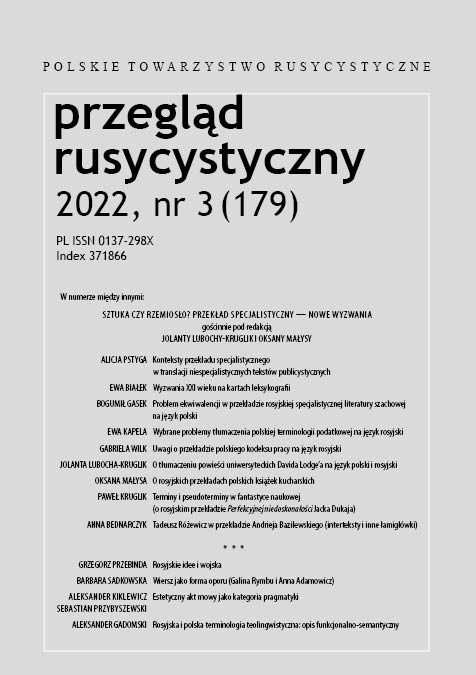
In the general typology of translation, journalistic texts belong to the group of non-fiction texts, in opposition to literary texts. Non-fiction texts also include specialist, technical and other texts. All these texts have their specific features which also influence their translation into other languages. Depending on the genre and topic, either aesthetic values or specialized vocabulary dominate in journalistic texts. Rendering them into another language requires different approaches and decisions made by translators to recreate the semantic potential. Various types of information are found in a journalistic text, determining translation strategies and the functions of the translated text. Translators make decisions considering the information which must be included in the translated text. Specialist terms which do not pose a problem for a competent translator may complicate the relations of inter-text equivalence, not only in communication, but also in the functioning of the translated text in the new context. With many text modifications, taking into account the recipient’s perspective, as well as the shortening of the text, which always involves omitting some information, certain details and specialist terms may be eliminated or replaced by non-specialist terms, which results in a deviation from the meaning of the original text. An analysis of parallel texts ilustrates this tendency.
The aim of this article is to present a selected lexis of Russian and Polish languages, which is increasingly used in contemporary texts. The author of the study pays attention to the various relations between language and reality: language as a reflection of reality, language as a tool for its interpretation and creation. The paper discusses such pairs of words as вызов / wyzwanie, хаб / hub, гуманитарный / humanitarny, гибридный / hybrydowy, the word абьюз, derivatives with the component кибер and their Polish equivalents, as well as collocations.
This article deals with the problem of finding Polish equivalents in the translation of Russian-language special chess literature. The focus of the article is on the general characteristics of chess literature in the form of the use, along with chess terminology, of informal and slang definitions, general sports and military phraseology and elements of an artificial semiotic system in the form of chess notation, symbols and diagrams. The variability and synonymy in the field of chess vocabulary, the problem of equivalence at the level of phrasemes and the question of the translator's subject knowledge are also analyzed. The text corpora containing 37 issues of the „64 – Shakhmatnoe obozrenie” and 14 chess books, as well as examples drawn from translations of chess literature and Polish media, is used as the source material.
The article focused on the difficulties with finding Polish-Russian translation equivalents for personal income tax terminology. The method of their fixation in specialized translation dictionaries is verified. In case of detecting the absence of an equivalent or its inadequacy, potential translation solutions are proposed based on parallel texts. The Polish- and Russian-language forms of annual personal income tax returns and the main regulatory legal acts that codify the terms used in the returns have been used as parallel texts. Based on the analysis, errors in translation dictionaries were identified, and recommendations for determining translation correspondences were formulated.
The article is devoted to the analysis of errors that occurred in the translation of the Polish labour code into Russian, published by the Wolters Kluwer in 2019. The translation of legal provisions from the printed version is compared with their translation, published in the LEX Legal Information System. Particular attention is paid to errors arising from a lack of awareness of how to translate legal texts and a lack of knowledge of the law. It is emphasized that the consistent use of a particular term in a legal text is important. Also, terms from different legal systems should not be used. According to the results of the analysis, it can be concluded that the electronic version of the translation is better than the printed one.
The subject of analysis in this article is the translation of David Lodge’s campus novels into Polish and Russian. The first two parts of his trilogy were chosen for analysis, namely Changing Places and Small World. University novels, typical primarily for English and American cultural space, have their own linguistic and genre specifics. Their authors are most often academic teachers; they also act as the main characters. No Wonder elements of scientific discourse appear on the pages of the novel and cultural elements related to the realities of University life, which are a challenge for translators.
The research will focus on Polish cookery books and their Russian translations. A particular focus will be placed on translation series сookery book by Maria Lemnis and Henryk Vitry Książka kucharka dla samotnych i zakochanych. Translation specificity of both texts is reflected not only in ways of finding appropriate equivalents for cuisine-related terminology but also, among others, in communication tactics adopted by translators. This will allow to show specificity of this genre, its varieties and modifications in the context of social transformations, behaviours as well as author-reader relationship.
This article is devoted to the problems of translating science fiction literature. As a material for analysis, a novel by well-known Polish fantasy writer Jacek Dukaj – Perfect Imperfection, was used. The author’s attention focused primarily on the problem of translating terms and pseudo-terms, as well as neologisms. As the analysis of the material in the Russian Translation has shown, the translation decisions generally coincide with the author’s intention of the original.
The paper examines translations of several poems by Tadeusz Różewicz translated by Andrey Bazilevski. They have been analyzed against other translations of this Polish author’s works, but above all we were interested in Bazilevsky's translational method and strategy characteristic for him.
The author concludes that the characteristic feature of this translator is, on the one hand, the desire to convey the typical features and character of Różewicz's poem, and, on the other hand, to explain unclear places of the text to the reader. Both strategies require a creative approach to the translation proces from the translator.
The article is a modified and slightly expanded version of the introduction to my book From Chaadayev to Solovyov. Russian Modern Thinkers between East and West, to be published in autumn 2022 by Peter Lang. Due to the exceptional circumstances in which this introduction article was written – and I mean, of course, the criminal war against Ukraine, unleashed by Putin on February 24, 2022 – in the above text, I try to present the general history of 19th-century Russian philosophical thought from the perspective of their attitude to both the universal humanist tradition of Europe and to militarist nationalism in Russia, often with a religious overtone. It is from this point of view that I consider in turn the essence of the worldview of Peter Chaadayev, Aleksandr Herzen, Nikolai Chernyshevsky, Feodor Dostoyevsky, and – most extensively – Vladimir Solovyov. In the background of all these thinkers, I also refer to Putin’s criminal “Orthodox worldview” and consider the essence of Alexander Solzhenitsyn’s philosophical and political thought in general, especially with regard to Ukraine and the European Enlightenment. An important place in this article is my discussion, but also a polemic – sometimes even fundamental – with some views on Russian thought, history, and politics by Andrzej Walicki, who died in July 2022.
In the article, the author considers the issue of the agency of poetry in the contemporary world, comparing two attitudes: Galina Rymbu and Anna Adamowicz. A comparative analysis of the works of both authors makes us realize that the degree of involvement depends on the personal situation of the writers. It is no coincidence that Rymbu expressis verbis emphasizes the need to break all conventions in poetry and exceed aesthetic norms that condemn women to silence. Her poetry is an example of civil disobedience, which feminist theorists (m.in. Judith Butler) wrote about. Its role would be to point out the potential for the opposition in every human body exposed to public view. Adamowicz, despite the fact that she belongs to the same generation as Rymbu, does not speak as radically as the poet from Russia. Her judgments about the agency of poetry are balanced and even sceptical. However, he believes that it has an effective potential, which in situations of great importance for societies in highly developed countries, redirects attention to problems removed from view (m.in climate crisis). The article's author does not hierarchize their poetry but notes some regularities, thanks to which Rymbu is a local poet and Adamowicz a global one. These labels are illustrative and do not disavow Adamowicz's work in favour of Rymbu. Their poetic activities are attuned to the political situation that organizes their poetic imagination.
The authors treat aesthetic speech acts as stimulating, i.e. within the category of determining speech acts (which also includes directive, interrogative, vocative and creative acts). A characteristic feature of stimulating speech acts is the nativistic nature of the determined mental state of the addressee. In formal terms, the peculiarity of aesthetic speech acts is that the use of discrete (lexical or grammatical) exponents of the illocutionary function is not possible in this case. To implement the aesthetic function, various elements of the part of the utterance containing information about the area of reference of the pragmatic function are used: 1) the semantic content of the text or utterance; 2) its form and structure; 3) context and communication situation; 4) translation of text/message, including the media. Due to their functional and formal features, aesthetic speech acts are divided into several subtypes: 1) macro-, meso- and micro-acts; 2) free vs. complementary acts; 3) determining the feeling of beauty or ugliness; 4) communicative vs. non-communicative.
This article is devoted to the functional and semantic description of the Russian and Polish terminology of theolinguistics. Russian and Polish lexicographic sources were used to analyze the interpretation of words that a priori can perform the function of theolinguistic terms; the features of their functioning in Russian- and Polish-language theolinguistic texts were studied; the selection and seminal analysis of Russian and Polish terms included in the conceptual and terminological field "theolinguistics" was carried out.


 10.31261/pr


 Język Polski
 Русский
 English