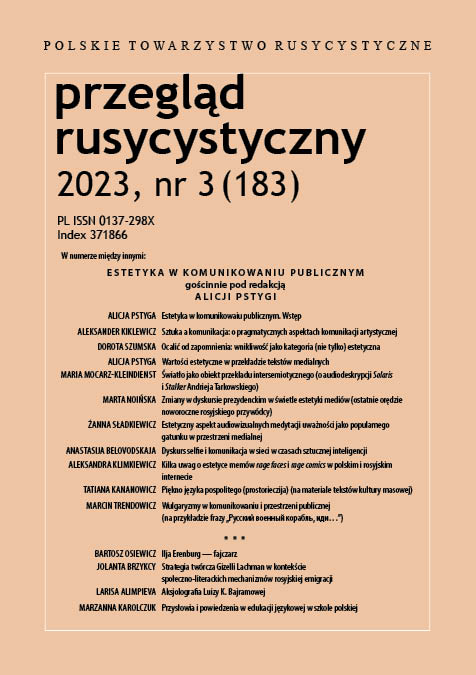
The subject of the article concerns aesthetic and artistic communication. The author assumes that many theories of social communication, as well as pragmatic theories, do not take into account language activities and discourses, the purpose of which is to evoke an aesthetic experience in the recipients. The author refutes such a view, presenting an alternative concept that aesthetic and artistic discourses meet the basic conditions of social communication: they rely on influencing through information; they are intentional; they are realized in interactions at the macro-social level within representative communication. The functionalist theory of culture by Bronisław Malinowski and the concept of aesthetic values by Ivor A. Richards will justify this approach to artistic communication. The author examines artistic discourses due to their synchronic and asynchronous character and proposes a typology of this type of discourses, illustrating particular types with examples from fiction.
The aim of the paper is to stress that in the crisis of verbality observed specially in mass communication there is an urgent need for changing the direction of the discussion about the aesthetic value of verbal texts which is in progress in philological community. The change proposed is that the priority should be given to intellectual value manifested by the gradual category which could be named for the purposes of presented considerations as the thoroughness of the text. The novelty lies in the fact that the thoroughness of the verbal content is viewed in the context of a possible application to detect AI-generated text which is the real challenge posed to the 21st century communication researchers.
Various forms of the aestheticization of everyday life are found in the multimodal media discourse, which – being strongly embedded in the social, cultural and political context – provides mediatized interpretations of reality. The aesthetic components found in press texts (apart from the aesthetics of verbal communication, in the visual code with the dominant role of photographs and graphics) influence not only the process of creating a press text, bur also its perception. In the paper, these issues are presented from the translation perspective. In the new (Polish) communication space, Russian press texts receive both a new language version and a new graphic design. This appears to be significant when we consider the aesthetic values of the texts and suggestions concerning their interpretation.
The article attempts to analyze the verbal exponents of lighting in audio description – a social service for the blind and visually impaired – for two films by Andrei Tarkovsky: „Solaris” and „Stalker”. It has been show that the following objects seen on the screen have their verbal representations in AD: the source of illumination, natural lighting as a signal of the time of day, radiance as a reflection of light rays, an opening in the room as a place where light travels, light-producing matter, the technique of presenting the image in the frame. Linguistic means are single lexemes with semantics of light, verbs, collocations. Among the stylistic figures distinguished: synesthesia, contrastive expressions, metaphors and comparisons. The study showed the cumulative nature of the description of light in short periods of time.
The aim of the article is a media aesthetic analysis of Vladimir Putin’s New Year’s address for 2023. The changes observed in the speech are symptomatic of the transformations within the presidential discourse that occurred during the Russian-Ukrainian war. In Vladimir Putin’s address for 2023, language, imagery, and music interact with the senses of the audience and complement each other to reinforce the message. The use of a new spatial arrangement and a change in linguistic aesthetics closer to antagonistic discourses make the armed conflict central to the entire speech. The address exhibits characteristic features of the current official Russian public discourse: a clear depiction of the enemy, explicit use of Us vs Them and binary oppositions, division of Russian society into loyal citizens and traitors who do not support the offensive in Ukraine, hyperbolization of Western actions and euphemization of military actions of the Russian Federation, and the combination of religious, Soviet, and military symbols.
Today, meditation is seen not only as an element of the religious and spiritual life of the broadly understood East, but also as a popular health practice available to any European media consumer, as well as one of the most sought-after applications of digital devices. The author describes the multilevel rhetorical structure and aesthetic organization of the mindfulness-meditation videos in Russian and Polish, emphasizing the harmonizing potential of the analyzed media texts.
The article is dedicated to exploring the perspectives of researching selfie discourse in the context of the emergence of a new actor - artificial intelligence - in the field of digital communication. Selfie discourse, which is currently attributed the status of one of the main catalysts of mass communication in social media and is considered one of the most specific characteristics of human communication, is examined in the article from the following aspects: 1) the specificity of selfie discourse as a category of so-called user-generated content, existing at the intersection of models of interpersonal (ru: Я – ОН) and autocommunication (ru: Я – Я); 2) the specificity of selfie discourse as a kind or diary-type narrative, based on the technique of auto-referential representation and, at the same time, focused on the view and assessment of the Other; 3) the specificity of selfie discourse as a multi-semiotic phenomenon.
In the article the author discusses the aesthetics of image and comix memes, which are regarded as one of the most indicative trends of organizing the utterance in the net and the most popular mean of expressing oneself in certain communities of cyberculture. Observations of these objects in the communicative environment allowed to identify a wide range of issues connected to aesthetics of everyday life such as: the genesis of the objects, nominations of the units, identification of the sign, motives, social behaviour and cultural and communicative practices, forms of self expression and pragmatical functionality of the units in global space and in Polish and Russian segments of the Internet.
In the article the wide-spread occurrence of the substandard language in the Russian public space is related to changes in cultural paradigms and uprising of the new type of culture – mass (popular) one. Formation of the new paradigm is accompanied by changes in statuses of the sender and the receiver. The last one gains the right to speak his own language and this language is substandard one. In the article the extracts from the the mass culture texts are discussed, in which substandard language becomes an element of aesthetics and poetics, which leads to changes in reception of beauty and ugliness in language.
The article is devoted to the subject of using vulgarisms in contemporary communication and in public space. To illustrate the issue, the phrase Russian warship, go… (Russian Русский военный корабль, иди…) was used. The phrase has been often employed in a variety of contexts, and now it functions as a precedent statement. The aforementioned subject has been also addressed within the aesthetics of communication.
The aim of the article is to look at the figure of Ilya Ehrenburg (1891–1967) through the prism of auto/biographical writing, which is a sketch for a literary portrait of the artist. This perspective will allow us to present the creative profile of Ehrenburg the pipe smoker, which emerges both from the texts of his contemporaries’, as well as from the writer's correspondence with friends and acquaintances. Ehrenburg's epistolary legacy introduced into the scientific circulation and the letters he received will make it possible to reconstruct his creative personality and artistic strategy, built largely on the influence of broadly understood European culture. For Ehrenburg, a pipe was not only a utilitarian object, but the expression of passion. In Russia, the pipe had mostly a European origin and for the writer it remained mainly a visible sign of life philosophy. Thanks to it, Ehrenburg successfully managed to attract the attention of the environment. What is more, the pipe taught him patience, favored self-reflection and helped measure the rhythm of the passing time.
The article concerns Gisella Lakhman (1895-1969), forgotten poet of the first wave of Russian emigration. Its aim is to discuss Lakhman’s creative strategy in the context of main mechanisms and processes for the literary life of Russian interwar and post-Second World War diaspora, such as: extremely difficult living conditions, deprofessionalization of the writer’s profession, a sharp reduction in the reading market, loss of ties with the native culture and language, and geographical fragmentation of the literary community. The new conditions of Russian literature abroad influenced Lakhman’s creative strategy, above all her late debut in the 1940s. Reasons and results of her decision are presented, as well as her position on the literary scene of the Russian diaspora, and reception of her work.
The purpose of this paper is to study the Axiological Phraseological Dictionary of the Russian Language: Dictionary of Values and Antivalues by Luisa K. Bayramova. This dictionary was the basis for seven more axiological dictionaries. The objectives of this dictionary are: 1) to introduce the user to Russian phraseology; 2) to enrich and expand the user’s knowledge of human and social values; 3) to help the user in the choice of axiology in his future.
The results of research on proverbs and sayings in linguistics and didactics show that paremia has cognitive, educational and pedagogical functions and, therefore, it is worth considering the use of these language units in school practice.
The purpose of the article is to propose exercises that can be used in the process of teaching a foreign language, as well as to present the results of the analysis of Polish textbooks for learning Russian as a foreign language in the context of the presence in these textbooks of exercises containing paremiological units. It was assumed that learning of a foreign language, can be done through four groups of exercises, such as: 1) exercises for identifying specific phenomena, 2) productive exercises, 3) exercises developing speaking and writing skills, and 4) reflexive exercises. We analyzed 14 textbooks published in Poland in 1999-2014. 267 paremiological units and 65 exercises with proverbs and sayings were found in all the teaching materials.
The study showed that the largest number of identified tasks relate to productive linguistic-cultural exercises. In the analyzed textbooks, exercises developing oral and written speech in Russian and reflexive exercises are practically absent.


 10.31261/pr


 Język Polski
 Русский
 English