
Archiwalny numer

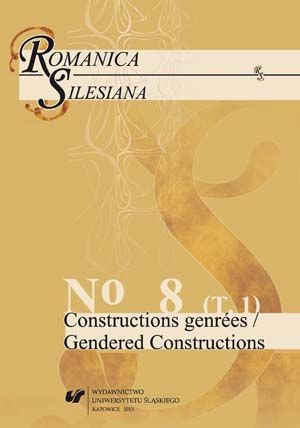
Vol. 8 Núm. 1 (2013)

Constructions genrées / Gendered Constructions

Rédacteur en chef Krzysztof Jarosz, avec la collaboration de Michał Krzykawski et Zuzanna Szatanik.
Número de artículos: 31

Cały numer

Cały numer

Idioma: PL | Fecha de publicación:


Czwórka redakcyjna

Czwórka redakcyjna

Idioma: PL | Fecha de publicación:


Table des matières / Contents


Introduction


Gender Studies in French

Michał Krzykawski , Zuzanna Szatanik
Idioma: EN | Fecha de publicación:


Du gender au genre. France et ses institutions

L’institutionnalisation des Gender Studies en France : un processus à plusieurs niveaux

Patrick Farges , Anne Isabelle François
Idioma: FR | Fecha de publicación: | Resumen

« Théorie du genre » et controverses d’égalité en France

Anne-Charlotte Husson
Idioma: FR | Fecha de publicación: | Resumen

REGINE or “Gender Goes Legal in France”

Mathias Möschel
Idioma: EN | Fecha de publicación: | Resumen

Selective Import: French Feminist Theory and Anglophone Critical Discourses

Tymon Adamczewski
Idioma: EN | Fecha de publicación: | Resumen


Corps sexuels / Sexual Bodies

Constructions de la subjectivité dans la littérature érotique féminine

Tomasz Swoboda
Idioma: FR | Fecha de publicación: | Resumen

Pudeur et impudeur comme modalités de construction d’un corps politique chez Hervé Guibert

Arnaud Genon
Idioma: FR | Fecha de publicación: | Resumen

L’objectif homonormatif de Virginie Despentes Bye Bye Blondie, du texte à l’écran

Audrey Dobrenn
Idioma: FR | Fecha de publicación: | Resumen


Jouer avec le genre / Playing with Gender

Hushed Bodies, Screaming Narratives: The Construction of Trans-Identity in 19th- and 20th-Century French Literature

C.J. Gomolka
Idioma: EN | Fecha de publicación: | Resumen

Pertinences et apories d’une lecture féministe de La Princesse de Clèves au regard de la théorie queer

François-Ronan Dubois
Idioma: FR | Fecha de publicación: | Resumen

Homosocial Bonds and Narrative Strategies in Adolphe Belot’s Mademoiselle Giraud, ma femme (1870)

Iwona Janicka
Idioma: EN | Fecha de publicación: | Resumen

Constructions du genre dans le roman policier « anti-norme » de Fred Vargas

Andrea Hynynen
Idioma: FR | Fecha de publicación: | Resumen

The Professional versus the Amateur A Case Study on Spanish Female Detectives and Their Role in the Masculine and Machista Organizations on the Examples of Selected Texts

Agata Tęcza
Idioma: EN | Fecha de publicación: | Resumen


Genre et discours féministes / Gender and Feminist Discourses

Discours littéraire et pensée féministe De Simone de Beauvoir à Simone Schwarz-Bart

Buata B. Malela
Idioma: FR | Fecha de publicación: | Resumen

Femmes et francophones Pour un dépassement des marginalités dans les constructions genrées

Hélène Barthelmebs
Idioma: FR | Fecha de publicación: | Resumen

Folle de Nelly Arcan (2004) : les « déterminations biologiques » dans la construction identitaire masculine

Christina Brassard
Idioma: FR | Fecha de publicación: | Resumen


Genre : le culturel et le social / Gender in Culture and Society

Les âges de l’intelligence féminine dans les textes scientifiques et littéraires du XVIIIe siècle français : éléments d’une théorie androcentrique

Adeline Gargam
Idioma: FR | Fecha de publicación: | Resumen

Quelle femme pour la République ? Le théâtre révolutionnaire et les représentations de la féminité

Tomasz Wysłobocki
Idioma: FR | Fecha de publicación: | Resumen

La féminité dans la littérature de jeunesse de langue française au Canada Une analyse de l’incomparable Mademoiselle Charlotte

Anne-Marie Dionne
Idioma: FR | Fecha de publicación: | Resumen


Représentations littéraires du genre / Literary Representations of Gender

Syngué sabour et Maudit soit Dostoïevski d’Atiq Rahimi : le féminin et le masculin dans le monde intégriste

Magdalena Zdrada-Cok
Idioma: FR | Fecha de publicación: | Resumen

Kamouraska d’Anne Hébert et Une si longue lettre de Mariama Bâ Un même « discours » féministe ?

Mbaye Diouf
Idioma: FR | Fecha de publicación: | Resumen
Kamouraska by Anne Hébert and Une si longue lettre by Mariama Bâ. A Shared Feminist “Discourse”?

Exploring a research angle never yet investigated by literary critics, this text proposes a comparative analysis of novels by writers Anne Hébert, of Québec, and Mariama Bâ, of Senegal. The study joins a new research domain by integrating literatures of the “North” and those of the “South”. Relations between men and women constitute a major focus in the novels, suggesting a social interrogation shared by both authors, as well as a common preoccupation for the feminine condition. Novels such as Kamouraska and Une si longue lettre seem to rewrite Augustinian libidos only through a systematic denunciation of religious and patriarchal discourse that declasses feminine subjects in the two societies. Their narrative and enunciative dispositions therefore organise literary subjects who, although particular in the works of each author, express, in a solidary manner, another way of being, as well as a “gendered” point of view.

Key words: Anne Hébert, Mariama Bâ, novel, discourse, feminism, enunciation, Québec, Sénégal.

-->

Les états de femme et la construction de la féminité dans la fiction durassienne

Anna Ledwina
Idioma: FR | Fecha de publicación: | Resumen

Sexual Politics: Mapping the Body in Marguerite Duras’s L’Amant

Richard J. Gray II
Idioma: EN | Fecha de publicación: | Resumen
In L’Amant (1984), through the juxtaposition of traditional male/female sexual roles, Marguerite Duras painted a gynocentric portrait of sexual politics. By depicting a series of encounters in diverse parts of the Indochinese (Vietnam) landscape, Duras’s novel described the sexual “coming of age” story of her female protagonist’s. Each Vietnamese setting became a visual and sensory metaphor for the various developmental stages of the protagonist. In this essay, I contend that Duras’s use of contrasting settings serves to “flesh out” the sexual politics conveyed in the novel. Herein, I examine the geographic locations illustrating the sexual politics of the novel, including the Mekong River signifying the female protagonist’s rite of passage, Cholon, the city where the girl experiences sexual liberation and a struggle with the established authority, the lover’s apartment where the couple consummates their relationship, and finally, France representing the land of wealth to which the protagonist will eventually return.

Key words: autobiography, Judith Butler, Cholen (Cholon), colonisation, crossing, gender, juxtaposition, Marguerite Duras, Julia Kristeva, liberation, liminal space, mapping the body, Mekong, Kate Millett, Other, post-colonial, prostitution, sexploitation, sexuality, sexual politics.
-->

Cela’s Men and Woman: Multiple Masculinities versus One Femininity in Mazurka for Two Dead Men

Anna Pilińska
Idioma: EN | Fecha de publicación: | Resumen

Femininity in the Position of the Oppressed in Nino Ricci’s Lives of the Saints A Comparison to Nelly Arcan’s Putain in Canadian and Quebec Literary Portrayals of Contemporary Womanhood

Ewa Drab
Idioma: EN | Fecha de publicación: | Resumen

L’image de la « belle Gitane » dans la littérature romantique allemande et française

Alice Le Trionnaire-Bolterauer
Idioma: FR | Fecha de publicación: | Resumen

« Le mythe du supermâle » : entre la France et le Maghreb dans La vie sexuelle d’un islamiste à Paris de Leïla Marouane

Magdalena Cebula
Idioma: FR | Fecha de publicación: | Resumen


Vol. 26 Núm. 2 (2024)
Publicado: 2025-12-01


ISSN: 1898-2433
eISSN: 2353-9887

Editor
Wydawnictwo Uniwersytetu Śląskiego | University of Silesia Press

Licencia CC

Licencja CC BY-SA

Este sitio web utiliza cookies para su correcto funcionamiento. Para aprovechar todas las funciones de la plataforma, acepte las cookies.
