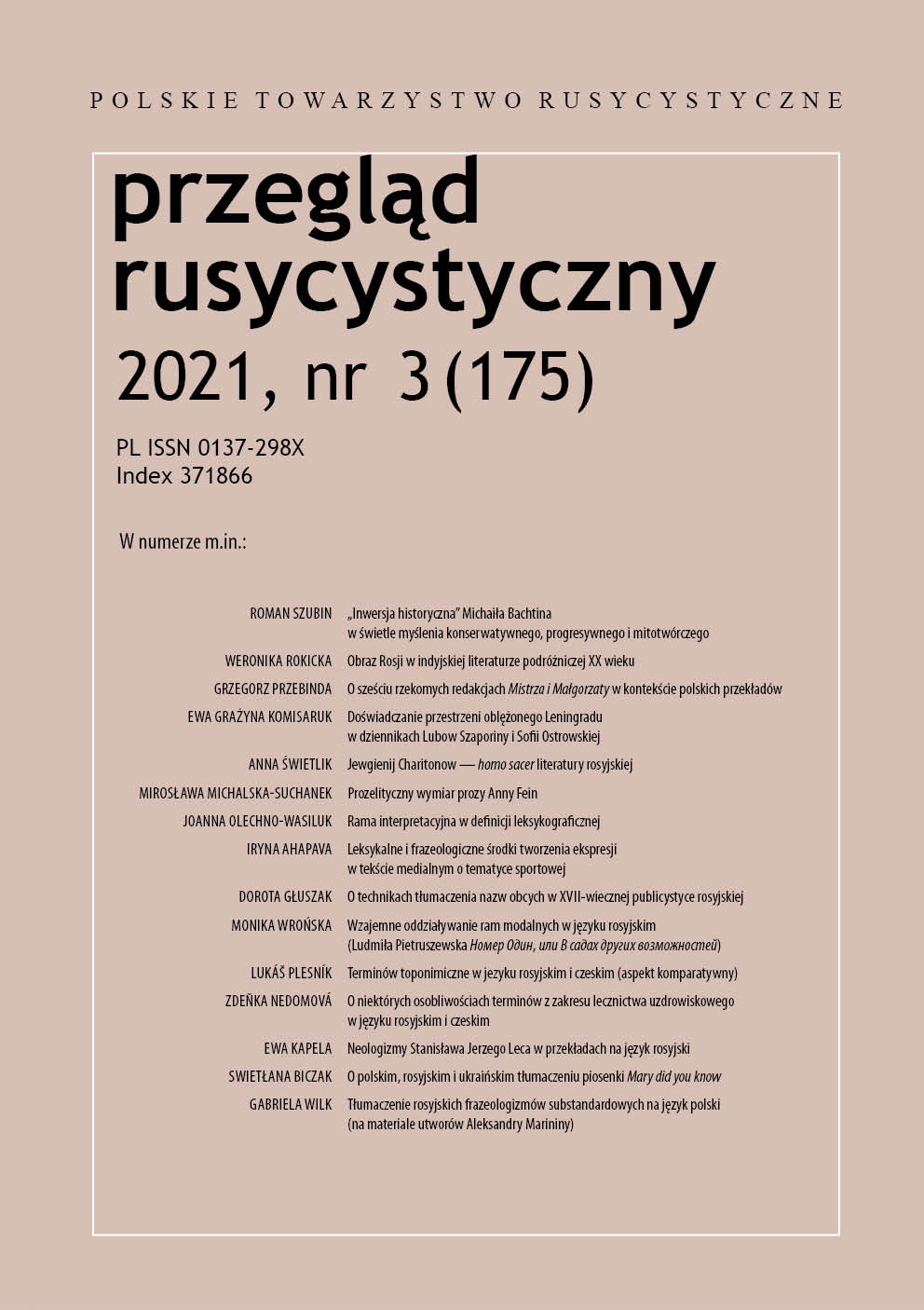
„Historical Inversion” by Mikhail Bakhtin in the Light of Conservative, Progressive and myth-making thinking Thinking
The article is devoted to the study of one of the poorly studied and mysterious concepts of Mikhail Bakhtin – “historical inversion”. First of all, the problem of the origin of this concept is investigated and, in connection with this, the concept of inversion-revolution is considered in the work of Oswald Spengler's “The Decline of the West”. Historical inversion is an attempt made by Bakhtin to criticize Aristotle`s doctrine of the entelechy. In a broad perspective, the concept touches upon the problems of confrontation on the West – East line. For a deeper understanding, an attempt is made to consider the “historical inversion” in the context of the opposition of progressive (Promethean), conservative (epimethean) and myth-making thinking within the framework of Vardan Hayrapetyan's folk hermeneutics.
The image of Russia in Indian travel writing of the 20th century
The article aims at presenting the overview of Indian travel writing on Russia in the 20th century and analysing the image of Russia emerging from Indian travelogues. Although most Indian travellers headed towards England, with the growth of anticolonial sentiment Russia gradually became a significant destination since the 1930s. Rabindranath Tagore was the most prominent among Indian guests and his Letters from Russia (1931) are considered travel writing classic, a reference point for all later Indian travellers to the country. Vast majority of the Indian travel accounts focus on the political, social and cultural changes in the country and set Russia as an example for India to follow, especially in the fields of education, culture or workers’ rights. They leave little space for any other aspects of the reality and unsurprisingly the fascination easily fades away with the collapse of the USSR.
The above study was created as a result of long, conducted in 2017-2020, archival research on the manuscripts and typescripts of the Master and Margarita, kept in the writer’s two Moscow archives. The author of the text concludes that not all Polish translations are based on the most canonical version of the original, some of them do not provide the source of the original Russian basis of the text, and two translations – the oldest by Irena Lewandowska and Witold Dąbrowski and the youngest by Jan Cichocki – even mislead the reader what to the source, mainly for commercial purposes. The main goal of the above article is, however, a partial description of the fascinating adventures of Bulgakov’s text, ending with the conclusion that the Author did not manage to create a canonical version of his masterpiece. This, unfortunately, allows some translators and critics to formulate fantastic textological hypotheses about the Master and Margarita, having absolutely nothing to do with reality.
The article analyses these fragments of the diaries by Lyubov Shaporina (1879-1967) and Sofia Ostrovska (1902-1983), in which the space of the besieged Leningrad is perceived from the perspective of a human being-in-a city. The following issues were central to the considerations: the way of viewing, presenting and evaluating the urban landscape, the specificity of the "spatial" behaviour of the Leningrad residents (especially the "technique" of moving around the besieged city) as well as reflections and associations of the authors connected with the city pictures showed in the diaries.
The article attend to the work of Yevgeny Kharitonov: the circumstances of the publication of copyright collections, as well as the distinguishing features of the works are presented. Also has been taken an attempt to determine the place of a homosexual literary character located in the soviet social space. The study was carried out using the concept of modern philosophers - Giorgio Agamben and Julia Kristeva, as well as scientific works in the field of social queer theory.
The works of Anna Fein follow the trend of returning to the roots of Jewish culture and traditional Jewish spirituality. The writer links the national identity with religious identification. Her narrators-protagonists follow the path that she once went — building Jewish self-awareness until conversion to Orthodox Judaism. In this evolution, which is the foundation of the semantic-ideological dynamics of most of the writer's works, a kind of Fein proselytism is revealed. The proselytical nature of Fein's prose is also a derivative of the cognitive function, i.e. introducing the secular recipient to the world of the orthodox community. The power of proselytizing resonance is also definitely strengthened by the autobiographical elements present in Fein's work.
The paper is focused on analyzing a lexicographic definition in the Russian ideographic dictionary The world of man and the man in the surrounding world. Having in mind characteristics of a cognitive definition, the author undertakes an analysis of selected entries and investigates applying interpretative frames in the presented dictionary. The analyzed entries are juxtaposed with reactions to particular words-stimuli from the Russian Dictionary of Associations, and it is compared how an interpretative frame introduces order and organization into the knowledge on a given linguistic unit, that is the knowledge on a given fragment of the world surrounding the Russian people.
This work is devoted to the analysis of media texts expressive means sportswriter at the lexical level (stylistically colored vocabulary, case law, paths, paradigmatic connections, deviations from the norms, etc.). This article shows the quantitative characteristics of the identified means of expressing the text and the dependence of the use of these means on the text of the text.
The following paper presents techniques which arise in connection with translating nouns of foreign origin in Russian opinion journalism. Translational texts published under the common name of Vesti-Kuranty served as the source. The material for analysis was extracted from all available editions of the manuscripts produced in the years 1600–1670. The aim of the article is to present selected techniques used by 17th-century translators which were meant to serve as prompts for understanding words unknown in Russian at that time, as well as to demonstrate different translation solutions aimed at introducing foreign phrases and values.
The article is devoted to semantical and structural characteristics of the interplay of modus frame in Russian language in Lyudmila Petrushevskaya's novel Number One, or In the Gardens of Other Possibilities. The subject of analysis were positions of the modus frames against each other in a sentence. The type of subject of modus frames was also highlighted. Theoretical issues, the crucial ones for the relevant issue, were characterized briefly; such as: modus, dictum, and a modus frame.
The article is devoted to the problems of generic components of toponymic terms of the Russian and Czech languages. The focus of attention is both on the main terms of the studied problem (toponymy, toponym, generic component), and the process of translation of specific generic elements and generic terms. The analysis is carried out in the Russian-Czech comparative plan, the generic components of toponymic terms, related mainly to choronyms, oronyms and hydronyms, are investigated. The translation process is implemented in the appropriate terms of the host language. On the one hand, most of the generic components under study have direct equivalence in the translation process, however, on the other hand, there are also generic components, which are replaced during translation by a not quite matching generic component, i.e. they are translated with the help of semantically nearby lexical units.
The article is focused on the issue of spa treatment terminology – a field of clinical medicine, from the perspective of language contacts and translation. The specialized terms of balneology, which is a part of spa treatment, are described and analyzed with respect to their specifics regarding the semantics, structure and origin. We mainly focus on the terms containing so-called analytical adjectives. The article indicates the cases of terminological synonymy and the Czech terms of different structural types are presented to equal the Russian terms. The research is performed on the basis of confrontation analysis of the balneology terms in both the languages.
The article discusses the methods of translating Stanisław Jerzy Lec’s Unkempt Thoughts into Russian in which neologisms constitute the basis of the wordplay. There are a lot of language innovations in Lec's aphorisms, but the article analyses only one-word neologisms, mainly blend words. The study of the series of translations presents various translators’ choices, which often result from different ways of interpreting the original text by translators.
Insufficient attention has yet been paid to the translation of religious texts in the scientific literature. The subject of the description in this article is the translation of the Christmas song Mary did you know into Polish, Russian and Ukrainian. The conducted analysis allows to determine the specificity of the translation transformations made in order to convey both the content and the poetic form of the religious text.
The article focuses on selected aspects of the translation into Polish Russian phraseological units that are beyond the linguistic norm. The research material has been excerpted from two Alexandra Marinina’s detective novels Requiem and Unwilling Killer and their translations by Alexandra Stronka. The research findings indicate that Stronka most often translates sub-standard phraseological units by means of idioms based on a different image, or lexemes, but these units not frequently differ from the original units in terms of expressive and stylistic coloring.
This review presents the author's views on the book Red and White, which deals with the multivariance of color symbolism of the political language of revolutions in France and Russia. Writers' ideas about color political language of that historical period are reflected in their literary works. The characteristic features of white, red, black and blue colors, which carry an active visual call at all times, are highlighted and described. Conducting his own analysis of the identity of the color palette of the French tricolor and Russian tricolor flags, the author of the article is based on the principles of perception of color by representatives of various ethnic groups, based on the experience of processing external impressions and mentality.


 10.31261/pr


 Język Polski
 Русский
 English