
Archiwalny numer

No. 4 (2018)

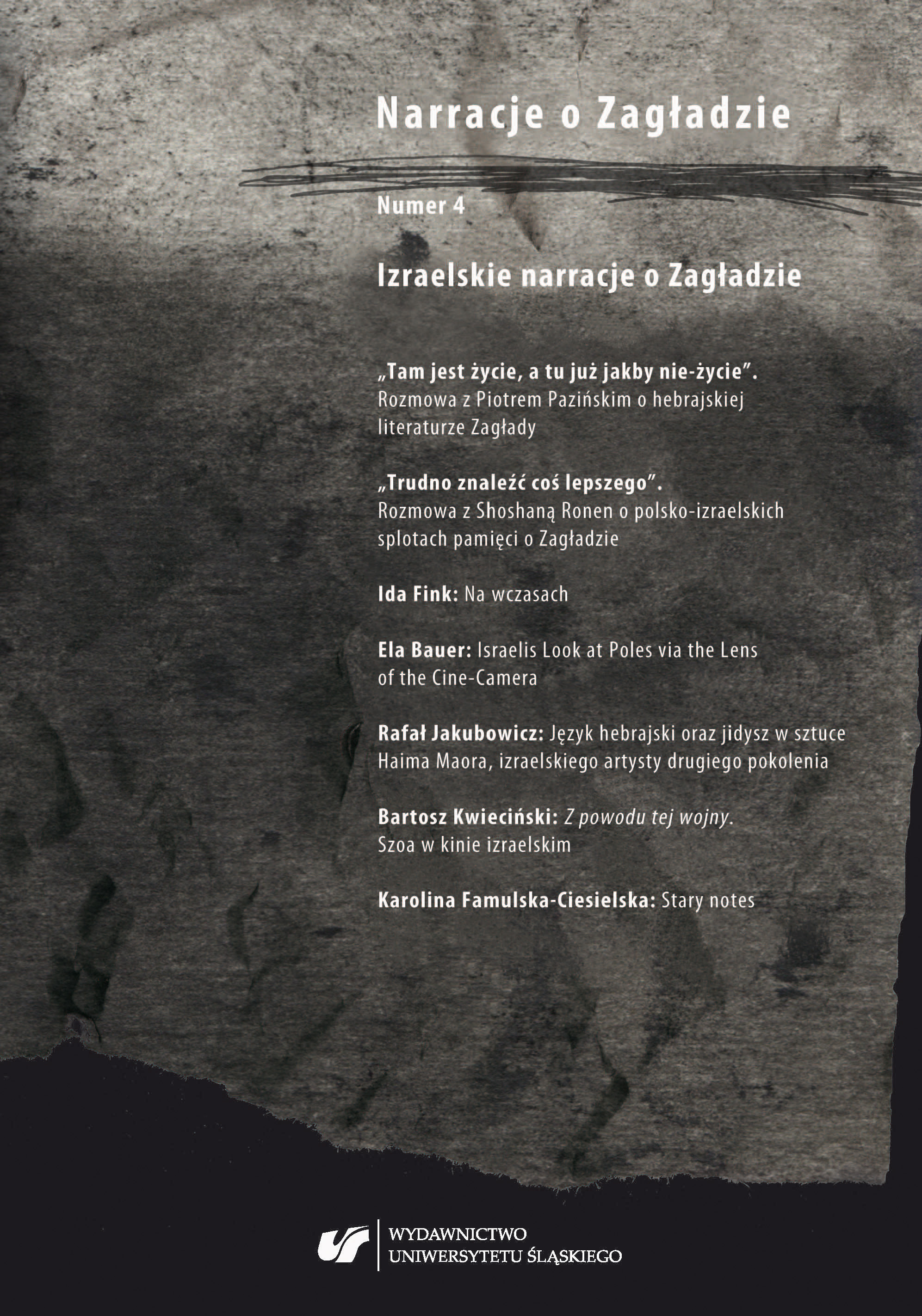
Narrations of the Shoah 2018, no. 4: Israeli narrations of the Shoah

Published: 2019-12-08

The fourth issue of Narrations of the Shoah is an attempt to grasp the way the memory of the Shoah functions in the Israeli narrations, even if in the fragmentary and by no means exhaustive form, and an endeavour to confront its complex network of contexts. This unique situation makes the stories written or encoded in this milieu an essential and fascinating reservoir of topics, plots, and tropes: fascinating also because of its inherent idiosyncrasy. In order to make them justice, we resigned from the chronological order of the text in favour of the one that organises them with regard to their topics; after all, memory flows in a nonlinear way, whereas the emergence of new tendencies does not necessary wipe out the older trends. Hence, we do suggest to read the texts we proudly present as an attempt of a fragmentary diagnosis of a status quo. Polish and Israeli insight into the archive of collective memory is confronted with the recent events that shape the contemporary Israel, including the social unrest and military conflict facilitated by the activity of the occupational army. All of these facts lead us to pose the following question: what has been told by the Israeli narration of the Shoah except for the Shoah? This is precisely the question the contributors to this issue endeavour to respond to. We wish you an inspirational reading! [from the introduction by Jagoda Budzik and Bartłomiej Krupa]
Number of Publications: 32
NoZ_4_2018 (Język Polski)

Title Pages and Contents

Strony tytułowe i spis treści

Marta Tomczok
Language: PL | Published: 01-12-2018 | Abstract | pp. 1-5


Introduction

Israeli narrations of the Shoah

Jagoda Budzik , Bartłomiej Krupa
Language: PL | Published: 03-11-2018 | Abstract | pp. 7-11


Israeli Narrations of the Shoah

“Life Is There, but Here – This Is Rather Non-life.” On Hebrew Literature of the Shoah. Piotr Paziński in Conversation with Jagoda Budzik and Bartłomiej Krupa

Piotr Paziński , Jagoda Budzik , Bartłomiej Krupa
Language: PL | Published: 03-11-2018 | Abstract | pp. 15-40

“It Is Hard to Find Anything Better.” On Polish-Israeli Weaves of Memory of the Shoah. Shoshana Ronen in Conversation with Jagoda Budzik and Bartłomiej Krupa

Shoshana Ronen , Jagoda Budzik , Bartłomiej Krupa
Language: PL | Published: 03-11-2018 | Abstract | pp. 41-54

Mi-Szoa li-tkuma. Poland as an Antinomy of Israel

Jagoda Budzik
Language: PL | Published: 03-11-2018 | Abstract | pp. 55-66

“My friend from Haifa said that when he dreamed, he dreamed not about the enemy, but about himself”. Studies on the Palestinian-Israeli Conflict as a Challenge for the Holocaust Studies

Marta Tomczok
Language: PL | Published: 03-11-2018 | Abstract | pp. 67-80

Because of This War. The Shoah in Israeli Cinema

Bartosz Kwieciński
Language: PL | Published: 03-11-2018 | Abstract | pp. 81-95

Obraz ocalałych z Holokaustu w izraelskich filmach pełnometrażowych powstałych po wojnie sześciodniowej

Liat Steir-Livny
Language: EN | Published: 03-11-2018 | Abstract | pp. 96-112

Izraelczycy spoglądają na Polaków przez obiektyw kamery filmowej

Ela Bauer
Language: EN | Published: 11-11-2018 | Abstract | pp. 113-137

Dotykalna trauma: o geście artystycznym Brachy L. Ettinger

Anna Kisiel
Language: EN | Published: 11-11-2018 | Abstract | pp. 138-162

Hebrew and Yiddish in Works by Haim Maor, an Israeli Artist of the Second Generation

Rafał Jakubowicz
Language: PL | Published: 11-11-2018 | Abstract | pp. 163-233

My Own Vineyard...: Autobiography or Auto(thanato)graphy?

Katarzyna Kuczyńska‑ Koschany
Language: PL | Published: 11-11-2018 | Abstract | pp. 234-244

Impossible Returns, Unavoidable Returns – Conventionality and Topicality in Miriam Akavia’s Prose

Agnieszka Czyżak
Language: PL | Published: 11-11-2018 | Abstract | pp. 245-258

A‑ alternative Story. On See Under: Love by David Grossman

Beata Przymuszała
Language: PL | Published: 11-11-2018 | Abstract | pp. 259-268

Return to the Planet of Auschwitz. Yehiel De‑ Nur’s Collapse as the Key Moment in Creating the Memory of the Shoah

Sara Herczyńska
Language: PL | Published: 11-11-2018 | Abstract | pp. 269-279


Articles and Studies

Interrupting When the Murderers Talk. Paul Celan on the Reception of His Works in the Context of Postwar German‑language Artistic and Political Discourses

Antoni Zając
Language: PL | Published: 11-11-2018 | Abstract | pp. 283-297

“Sense of Participation.” Communities, Alliances of the Vulnerable and the Subservient in Halina Poświatowska’s Poetry

Andrzej Juchniewicz
Language: PL | Published: 11-11-2018 | Abstract | pp. 298-324

Silence about the Shoah. Tropes of Memory in Piotr Sommer’s Poetry

Ewa Goczał
Language: PL | Published: 11-11-2018 | Abstract | pp. 325-348

Singing the Unsingable? The Position of the Musical in Holocaust Education

Joanna Roszak
Language: PL | Published: 11-11-2018 | Abstract | pp. 349-361


Translations

Prose of the Second Generation: Other Ways of Remembering

Talila Kosz Zohar , Jagoda Budzik
Language: PL | Published: 11-11-2018 | Abstract | pp. 365-383


Documents

On Holiday

Ida Fink , Bartłomiej Krupa
Language: PL | Published: 11-11-2018 | Abstract | pp. 387-394

An Old Notebook

Karolina Famulska‑Ciesielska
Language: PL | Published: 11-11-2018 | Abstract | pp. 395-399

Mizocz - A Palimpsest

Ewelina Suszek , Natalia Parfeniuk
Language: PL | Published: 11-11-2018 | Abstract | pp. 400-408


Overviews and Commentaries

A Mole or a Whale? Which Way Is It to Rechnitz? Sacha Batthyany: A co ja mam z tym wspólnego? Zbrodnia popełniona w marcu 1945 roku. Dzieje mojej rodziny. Trans. Emilia Bielicka. Warszawa, Czytelnik, 2017, 256 pp.

Kinga Piotrowiak-Junkiert
Language: PL | Published: 11-11-2018 | Abstract | pp. 411-416

„Meticulous Work.” Dorota Głowacka: Po tamtej stronie. Świadectwo – afekt – wyobraźnia; Anita Jarzyna: Imaginauci. Pismo wyobraźni w poezji Bolesława Leśmiana, Józefa Czechowicza, Krzysztofa Kamila Baczyńskiego, Tadeusza Nowaka

Andrzej Juchniewicz
Language: PL | Published: 11-11-2018 | Abstract | pp. 417-431

Back Then, before the Shoah. On the Book That Retrieves the Jewish Life of Berlin and Warsaw. Alina Molisak: Żydowska Warszawa – żydowski Berlin. Literacki portret miasta w pierwszej połowie XX wieku. Warszawa, Wydawnictwo IBL PAN, 2016, ss. 365.

Katarzyna Kuczyńska‑Koschany
Language: PL | Published: 11-11-2018 | Abstract | pp. 432-442

A True Story (Made of Nuances). Anna Bikont: Sendlerowa. W ukryciu. Wołowiec, Wydawnictwo Czarne, 2017, ss. 480

Daria Nowicka
Language: PL | Published: 11-11-2018 | Abstract | pp. 443-454

Reading and Memory Małgorzata Wójcik-Dudek: W(y)czytać Zagładę. Praktyki postpamięci w polskiej literaturze XXI wieku dla dzieci i młodzieży. Katowice, Wydawnictwo Uniwersytetu Śląskiego, 2016, ss. 336.

Joanna Żygowska
Language: PL | Published: 11-11-2018 | Abstract | pp. 455-462

Israel, Untamed On the Diversity of Literary Representations Paweł Smoleński: Izrael już nie frunie. Wołowiec, Wydawnictwo Czarne, 2006, 320 pp. Ela Sidi: Izrael oswojony. Warszawa, Muza, 2013, ss. 560.

Anita Jasińska
Language: PL | Published: 11-11-2018 | Abstract | pp. 463-471

“Who has forged the pepper?” Monika Sznajderman: Fałszerze pieprzu. Historia rodzinna. Wołowiec, Wydawnictwo Czarne, 2016, ss. 280.

Paulina Czwordon-Lis
Language: PL | Published: 11-11-2018 | Abstract | pp. 472-480

Work in Progress Work in Progress. Konfrontacje trzeciego pokolenia po Zagładzie. Red. Jagoda Budzik. Kraków, Wydawnictwo Pasaże, 2018, ss. 112.

Bartłomiej Krupa
Language: PL | Published: 11-11-2018 | Abstract | pp. 481-486


Biographical Notes

Noty o Autorach

Marta Tomczok
Language: PL | Published: 01-12-2018 | Abstract | pp. 487-493


No. specjalny (2021)
Published: 2021-06-21


ISSN: 2450-4424
eISSN: 2451-2133

Publisher
Wydawnictwo Uniwersytetu Śląskiego | University of Silesia Press

Licence CC

Licencja CC BY-SA

This website uses cookies for proper operation, in order to use the portal fully you must accept cookies.
